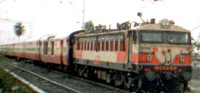
| India's longest rail tunnel opens in Valley
Qazigund (Kulgam), December 28, 2012:
The 11 km-railway track, which cuts through the foothills of the Pir
Panchal mountain, has not only bridged the two passes of the mountain
but infused a sense of hope of prosperity and development among the villagers along the tracks, who are for the first time witnessing a
running train.
The Rs. 1300-crore tunnel is bound to be a major tourist attraction
after the 2.75 km Jawahar tunnel on Srinagar- Jammu highway. The new
tunnel is second longest in Asia after Chinese one. The tunnel passes
440 metres below the existing Jawahar Tunnel. With the speed of 100 km
per hour, it will take around seven minutes to cross the tunnel.
Earlier, prime minister Manmohan Singh flagged off Qazigund-Baramulla
railway track within the valley. But the tunnel through the Pir Panjal
will finally connect the valley with the plains in Jammu and the rest of
the country. The tunnel is likely to be inaugurated next year.
"The Pir Panjal Tunnel is a major part of Udhampur - Srinagar -Baramulla Broad rail line project. It connects the Bichleri valley at
the south side with the Kashmir valley on the north side. The nearest
town in south and north side is Banihal and Qazigund respectively," said
railway officials. The entire project between Dharam, across the Jawahar tunnel, and
Qazigund in the valley is 56.54 km, which comprises of 14 tunnels of
total length of 44.50 km and 48 numbers of major and minor bridges.
Railways imposes Rs 500 fine for spitting on platforms
MUMBAI, December 18, 2012: The railways has decided to levy fines of up to Rs 500 from
those who spit on platforms or litter or deface walls on railway premises. The railway ministry has empowered station
masters/ managers and ticket collectors to collect the amounts. The ministry has issued a notification of rules on the prohibition of
activities affecting cleanliness and hygiene on railway premises.
The notification—brought out on November 26—also specifies penalties for
violating the rules. According to it, no person shall in any occupied or
unoccupied railway premises or carriages (except in authorized places):
throw or deposit litter; cook, bathe, spit, urinate or defecate; feed
animals or birds; repair or wash vehicles; wash utensils or clothes or
any other objects; store personal objects; paste posters on walls; deface walls or train compartments. By authorized places, the railways
means lavatories, waste baskets and locker rooms.
The railway ministry has asked authorized vendors and hawkers to arrange
for containers for waste collection and to ensure their disposal. "Till now, Indian Railways did not have specific rules on civic sense,
and offenders were booked under provisions of the Railways Act
," said a senior railway officer. "But by notifying cleanliness and sanitation rules, the
railways have made station masters and ticket collectors responsible for
maintaining cleanliness at stations and on trains." Source: Times of India
Railway earnings register 19% rise
ALLAHABAD,
December 11, 2012: The total approximate earnings of Indian Railways
on originating basis between April and November 2012 were Rs 78,868.17 crore compared to Rs 66,150.48 crore during the same
period last year, registering an increase of 19.23%.
The total goods earnings went up from Rs 43,891.25 crore
during April-November 2011 to Rs 54,487.10 crore during April-November 2012, registering an increase of 24.14%. The total
passenger revenue earnings during April-November 2012 were Rs
20,423.31 crore compared to Rs 18,742.83 crore during the same
period last year, registering an increase of 8.97%.
The revenue earnings from other coaching amounted to Rs
2,061.30 crore during April-November 2012 compared to Rs 1,860.49
crore during the same period last year, registering an increase of
10.79%. The total approximate numbers of passengers booked during
April-November 2012 were 5700.57 million compared to 5517.86 million
during the same period last year, showing an increase of 3.3%. In
the suburban and non-suburban sectors, the numbers of passengers
booked during April-November 2012 were 2964.50 million and 2736.07
million compared to 2886.10 million and 2353.95 million during the same period last year, showing an increase of 2.72% and 3.96%
respectively. Source: Times of India
Indian Railways needs Rs 1,47k crore to finish projects: Pawan Bansal
NEW DELHI, December 5, 2012: Railways has failed to manage funds for com pleting its long
list of pending projects, admitted rail minister Pawan Bansal on Friday. Faced with acute financial stress, the minister
announced that projects which are 50% complete will be taken up on a
priority basis and also urged state governments to share the cost. Bansal was candid in admitting that railways had been making new
announcements in response to demands of members, and was staring at a "humongous" financial commitment.
The minister disclosed that the state-run transporter needs Rs 147 ,187
crore for completing 347 pending projects relating only to laying of new
tracks, gauge conversion and doubling of tracks. Expressing helplessness to fund these projects, Bansal informed the
Rajya Sabha that in the past railways could manage only Rs 5,000 crore
annually for implementing all its projects. "Railways is one department where we have been making various
announcements for new projects in response to vociferous demands raised
by MPs. That has landed us in a situation where there is a humongous
throw-forward of projects, both in physical terms and financial terms,"
he said. Bansal argued that the due to large number of projects the financial spread has been
thin which is resulting in difficulty to finish work in time.
The minister defended rail officials arguing that the allegations of
time and cost overruns in finishing projects were technically incorrect
as work was being carried out in accordance with the money sanctioned.
Failing to generate resources, he urged state governments to share land
cost and 50% of the sum spent on construction to help the transporter to
expedite its pending projects. Source: Times of India
Indian Railways setting up 100 MW Thermal Power Plants in Bihar
Patna, 24 November 25, 2012: Indian Railways is establishing its first coal
based captive power plant of 1000 MW capacity at Nabinagar in Bihar
in JV with National Thermal Power Corporation which is under construction.
Indian Railways has further planned to set up 2 more captive power plants in Railway land, 1 1320 MW capacity coal based power
plant and Adra in Purulia district of West Bengal is JV with National Thermal Power Corporation and another 700 MW gas power
plant at ThakurIi near Kalyan in Maharashtra. Fuel linkage and environmental clearance for both these plants are is process. Annual
saving of about INR 500 crore from Nabinagar plant, INR 600 crore from Adra plant and INR 200 crore for Thakurli plant has been
estimated due to reduction in electricity tariff. Source - PIB
Railway Board plans to buy high-speed trains at Rs.550 crore apiece
Delhi, November 15, 2012: The Indian railways needs at least Rs.10 lakh
crore to enhance its safety measures and another Rs.1.25 lakh crore
to complete 129 key projects. These financial hiccups, however, have
not stalled the flight of ambition of the railway board, which has prepared a proposal to buy highspeed trains, which can travel up to
200 km per hour, at the cost of Rs.550 crore per train.
The "speed-up high quality coach trains" are
proposed to run on the Delhi-Mumbai route. The ambitious plan, involving an expenditure of Rs.10,587 crore for 20 speed-up trains,
has triggered a debate in the railway department with several members finding the project unfeasible given the current condition
of the railways. The feasibility study, presented in the railway board meeting on November 1, also took into account the additional
cost of three to four thousand crore rupees that would be incurred in setting up the infrastructure to run the high-speed trains. The
feasibility proposal has evoked sharp criticism from former board members and railway brass, with some sniffing a "scam" and
"favouritism" to a particular company.
"It is learnt that companies like Altstom, Bombardier
and Siemens are in the race to grab the contract. Japanese giants in the field - Hitachi, Kawasaki and Mitsubishi - are also not far
behind. Incidentally, the feasibility study for these trains was sponsored by Japan's ministry of economy, trade and industry (METI),''
a board member said. Many questioned the proposal's viability at a time when the railways is struggling to complete several pending
projects. A senior board member pleading anonymity said: "There are several pending issues which need urgent attention and are
affecting the daily operations of the railways. If we can run a highquality train at the cost of Rs.60-70 crore, including the
locomotive cost, why are we going for the high-speed trains which are 10 times more expensive? The proposal is impractical given we
don't have proper tracks to run even 100 km/hr speed trains."
The total cost earned from passenger fare per train will not
even be enough to pay the interest of the loan required to buy these trains. "Had it been an investment it would have been a
feasible approach. But that is not the case," the board member said. "Besides the Rs.11,000 crore cost of the train, also
consider the expenditure on the tracks. The cost of one km track for such high-speed train will be equivalent to the cost of 20 km of
normal coach tracks in use in the country. Source: INDIA TODAY
Indian railway, Indian railways news, Indian airways
Raebareli, November 8, 2012 (PTI): Congress President Sonia Gandhi flagged off
the first set of coaches from the modern Rs. 1,685 crore rail coach manufacturing factory inaugurated by her on Wednesday in her Raebareli
parliamentary constituency. The project was commissioned a few weeks after the Congress got the
Railway Ministry back after nearly 16 years, a portfolio last held by
former ally Trinamool Congress before its pullout of UPA in September. The foundation stone for the Railway Coach Factory (RCF) which is the
biggest project in Rae Bareli and the third in the country was laid in January 2009 just before Lok Sabha polls and the then BSP government in
Uttar Pradesh had termed it as a "political gimmick" on the eve of polls to gain political mileage.
"I here want to mention those who spread rumours against the project.
But it has been completed in such a short time", Ms Gandhi said at the
inaugural function at RCF in Lalganj. The land for the project was initially denied to the Railways, which had
then blamed the BSP government for delaying the start of project.
Stating that the factory would not only generate employment opportunities for locals but also ensure development of the area, Sonia
said full compensation was given to farmers by the railways for their land.
"The regional industries are likely to grow and locals will find new
employment opportunities", she added. Before flagging off 20 coaches
produced in the factory which would be used in Rajdhani and Shatabdi trains, Sonia inspected them and said she
as feeling elated.
"Railways on which 1.5 crore passengers travel every day is crucial for
the economy of the country. It is the biggest employer in which over 15
lakh employees work", Ms Gandhi said in the presence of Railways Minister Pawan Bansal. "I have seen how people in far away places in
Jammu and Kashmir were enthused when the service started there", Ms Gandhi added, trying to highlight its importance.
I-card mandatory for sleeper-class train passengers from 1st December
New Delhi, November 2, 2012:It will be compulsory for sleeper-class train passengers to
carry identity proof from December 1. This was announced by the Indian
Railways on Thursday. The Railways said that this move will reduce the
scope for misuse of tickets by touts. In February, Railways had made it mandatory for AC-class passengers to
carry identity proof with them. Passengers travelling on a Tatkal or an
e-ticket are also required to carry I-cards while undertaking train journey.
"Earlier it was mandatory for AC-class train passengers to carry
I-cards. Now, we have decided to make sleeper-class passengers also to
carry I-card. This has been done to facilitate genuine passengers to
avail confirm tickets," a senior Railway Ministry official said.
"Non- AC travellers were kept out of the photo I-card decision at that
time, the official said. He added, The policy ambit is being widened
now so that every passenger in reserved class onboard a train has a valid identity card.
From December 1, passengers failing to produce original identity proof
in sleeper class, as and when asked for, will be treated as without
ticket and charged accordingly. The rule will apply for all forms of ticket, including those for sleeper
class, issued by Railways through computerised passenger reservation system (PRS) or Internet.
The decision to introduce photo I-cards for sleeper class passengers is
likely to deter touts from booking tickets under fictitious names and
selling them to passengers at a premium, the official said. Passengers can carry any of these ten ID proofs while undertaking train
journey -- voter ID card, passport, PAN card, driving licence, photo
identity card having serial number issued by central/state government,
student identity card with photograph issued by recognised school/college, Aadhar card, nationalised bank passbook with photograph
and credit cards issued by banks with laminated photograph.Source: Agencies
Pawan Kumar Bansal is new Railways Minister
New Delhi, October 29, 2012: Pawan Kumar Bansal has been selected as the new Railways Minister. Prime
Minister Manmohan Singh expanded his cabinet on Sunday. Pawan Kumar
Bansal, 64, is a member of the 15th Lok Sabha of India. He was the Union
Cabinet Minister of Water Resources in the previous cabinet. He represents the Chandigarh constituency and is a member of the Indian
National Congress (INC) political party. He studied in Government
College Chandigarh. Pawan Kumar Bansal on Sunday said his priority will
be to improve the financial health of the national transporter and make it a preferred mode of journey in the country.
“My priority is to improve the health of the ministry both physical and
financial,” Mr. Bansal said in New Delhi after being given the responsibility of crucial infrastructure ministry.
Asked whether he will go in for a fare hike, Mr.Bansal said the task of
improving the financial health is a larger exercise. “It has to be a larger exercise. It does not have to confine to just
increasing fares or freight...That is not the only factor on what the
physical or financial health will depend upon,” he said. Besides Mr. Bansal, two Congress MPs from West Bengal and Andhra Pradesh
-- Adhir Ranjan Choudhary and Kotla Jaya Suryaprakash Reddy -- were given portfolios of Ministers of State for Railways in the reshuffle.
It is after almost one-and-a-half decade that the Railway Ministry is
back with Congress with Mr. Bansal being given the Cabinet post and the two MoS portfolios also going to the party.
On safety aspects, Mr. Bansal said, “My endeavour will be to make train
journey safe and comfortable so that it remains a preferred mode of transport in the country.”
Mr. Bansal said, “We have to look into many aspects to see if we can cut
on expenditures, where we can utilise the resources properly and if necessary how to go about the issue of fare, with the larger objective
of providing better services to the people.”
50 made-in-India railway engines to chug into Pak
New Delhi, October 26, 2012: India has finally agreed to sell and
lease out its locomotives to Pakistan, thus helping the neighbouring
country restart its defunct train services. In the first-of-its-kind deal, the Indian Railways will deliver 50
refurbished American Locomotive Company (ALCO) technology locos at an estimated cost of Rs. 350
crore. Another set of 50 new locos of a higher horsepower (3000-3500) will also
be leased out. Lease charges of Indian locomotives work out to Rs. 900
per hour or Rs. 21,600 per day. Pakistan is expected to get delivery of the first instalment of 10
refurbished engines of 2,000-2,600 horsepower capacity sometime next year.
The proposed arrangement will include a liberalised visa regime for
Indian engineers who will be required to visit Pakistan for training purposes.
While yearly maintenance of engines is proposed to be done at the Indian
Railways shed at Ludhiana, the Pakistan government has agreed to ramp up
facilities at its railway shed at Mughalpura near Lahore. Running 19,000 trains over a 54,000-kilometre network each day, the
Indian Railways is hugely stressed for train engines. "But the production units will churn out train engines in bigger numbers
in the coming years. Issues with Pakistan have now been sorted out. We
will shortly start working on the modifications and fix up the used locos to be delivered to Pakistan," officials said.
With 137 of its fleet of 494 locos dysfunctional, train operations in
Pakistan have virtually collapsed and annual losses worth a whopping R25
billion have been reported. In the last four years, the Pakistan government has provided Rs. 93 billion subsidy to its railways
department, Rs. 32 billion as assistance for development projects and
Rs. 14 billion as overdraft from the State Bank of Pakistan, railways
minister Ghulam Ahmed Bilour said recently. Source: Hindustan Times
Tatkal tickets: Indian Railways introduce separate reservation form
New Delhi,
October 20, 2012 (PTI): Stepping up efforts to check misuse of
tatkal bookings, Railways on Thursday said a separate reservation
form for passengers booking tickets under this scheme will be
introduced soon. The pink colour form has to be filled up by the
passenger at the booking counters providing details of his/her
address, contact number and ID. At present a single requisition form
is available for booking both normal and tatkal tickets. The form
also carries a set of warnings including deboarding at the next
station, imposition of fine or imprisonment as per provisions of
Railway Act if address and other details furnished are found to be false.
Announcing the move, GM Northern Railway V K Gupta said more than five lakh multiple personal IDs and 44,000 IDs created by
agents have been deactivated since February 2011 by the IT
anti-fraud team of IRCTC as part of efforts to check misuse of
ticketing service. Opening time of tatkal booking was changed from 8
am to 10 am earlier this year. Gupta said 62 pairs of special trains
would be run this festive season to clear the rush of passengers.
Elaborate security arrangements have been made in major city
stations with augmentation of workforce and ensuring proper crowd
management, he said. The arrangements also include timely placements
of the rake at the platform and keeping a check on elements
cornering seats in coaches. -PTI
Rs 10,000 cr bonus for railway employees
New Delhi,
October 17, 2012: After a series of decisions aimed at pushing its
economic reforms, the UPA government is set to focus on a slew of
pro-people measures. The Union cabinet will discuss a proposal to
shower Rs. 10,025 crore as bonus on railway employees in its meeting
on Thursday. The proposal for disbursing productivity-linked bonus
will benefit almost 12.37 lakh employees of the Indian Railways —
the biggest government employer. If the plan gets approved, each
railway employee will get almost Rs. 9,000 as bonus for 2011-12. The
proposal, seen as one of the biggest sops for government employees,
also comes after the exit of Trinamool Congress member Mukul Roy as railway minister.
The cabinet is also set to increase its expenses on the
national social assistance programme (NSAP). The proposal is to
double the amount of monthly financial assistance to widows,
disabled and other vulnerable sections of the society.
According to the proposal, the Indira Gandhi Widow Pension
will be hiked from Rs. 200 to Rs. 300. Also, if the sole bread
earner of a poor family became disabled, the government used to
provide a one-time grant of R10,000 apart from a monthly pension.
The cabinet seeks to double the grant. Source: Hindustan Times
Indian Railways allows users to track train info real-time
Mumbai October
12, 2012: The Indian Railways is now allowing passengers to track
trains on real-time basis. RailRadar is an interactive map which
allows users to watch movements of trains, which are currently
running in India. The application was today announced at the Digital
Conference held by Medianama. This is the first time any of the
public transport system can be tracked in real-time basis on the
internet, and mobile. RailRadar is a live tracker of Indian Railways
passenger trains traffic in real time. This live tracker is shown on
an interactive map and allows users to watch the movements of trains
which are currently running in entire India. The application has
been built by Indian Railways Center for Railway Information System
(CRIS) and RailYatri.in. The map has arrows in various directions and colours. A single yellow or
red icon represents train currently running in India. A yellow icon
represents a train which is currently expected to reach its next
stop on time (typically with delays of 15 mins or less). A red icon
represents a running train which is delayed by more than 15 minutes.
The pointer of the icon represents the direction in which the train
is traversing. To be able to give information on real-time basis,
the application extracts and harnesses volumes of data from the
official Indian Railway's train running operational information
data. According to the official website (http://railradar.trainenquiry.com/),
in terms of accuracy, the information is fairly accurate in the
normal running scenarios. Indian Railways has train passing
monitoring points around the country at more than 6000 locations.
These monitoring points in real-time mode communicate updates on
train arrival, departure, or passing to a central headquarter
server. In substantial cases these updates are automated however
there are places/situations where this reporting is also done
manually. ?There are several factors that can affect a train while
it is on its route. Weather, breakdowns, congestion, local
control-office directives, and more. RailRadar tries to continuously
update this information. However, since the data on the Radar is
displayed few minutes later than the actual, we encourage our
viewers to double check train running information using the
traditional train status search mechanism also offered by
TrainEnquiry.com,? explain the website. Source: Business
Standard
Online tracking site of Indian Railways now to have info of all trains
NEW DELHI, October 6,
2012: Expanding its facility, Railways have included all trains
under its online train tracking service, trainenquiry.com, providing
updated information about their movements. According to a statement
issued on Thursday, train running information can also be sources by
sending SMS to 139. All that one has to do is type 'SPOT' and send
it to 139. The development comes in the wake of real-time train
tracking system SIMRAN ( Satellite Imaging for Rail Navigation
developed by IIT-Kanpur shutting down operations recently.
The agreement between Railways and IIT-Kanpur has come to an
end for running the project on September 30, sources in the Railways
said. While SIMRAN provided information of only 36 selected Rajdhani
and Shatabdi trains, the statement said, information on all these
trains would be available on 'www.trainenquiry.com'. - Times of
India
Railway steps up security for women
New Delhi, October 03,
2012: The railways have stepped up security for passengers,
especially women, after an Indian Administrative Service (IAS)
officer was arrested for allegedly misbehaving with a woman—an
employee of an MNC in Noida —on board an AC coach of a Delhi-Lucknow
train on Monday. "All important trains have mobile squads of
either our Railway Protection Force (RPF) or the states' Government
Railway Police (GRP). Instructions have been issued to maintain
extra vigilance and check such cases in future," said a senior northern railway official.
"We're making passengers aware that there are attendants
in all AC coaches. They can be spoken to in case any passenger
perceives any threat or feels insecure," he said. "Any
complaints of crime can be lodged at the next major station. We have
displayed helpline numbers of the railways as well as the GRP in
trains and at stations," the official added. Citing lack of
adequate manpower as a major problem, another railway ministry
official said, "Our priority is railway board's trains such as
Rajdhani and Shatabdi, followed by express and mail trains run by
various zonal railways. Because of staff shortage, small-distance
and daytime trains often suffer."
"Also, there is no adequate coordination between RPF and
GRP. Efforts are on to introduce a bill in Parliament to transfer
handling of all heinous crime cases to RPF," the official said.
RPF is responsible for the detection of crime and protection of
passengers but unlike GRP, it does not have the powers to lodge FIRs,
investigate, and arrest offenders. RPF has for long been ruing the
fact that the GRP —even after detection of crime—does not lodge
cases citing jurisdiction issues. - Hindustan Times
AC train fares, freight rate go up from October 1
New Delhi September 28, 2012 (PTI) All AC train fares, freight tariff and cost of food at railway stations
will go up from October 1 with the coming into force of service tax on
them. This follows a decision taken at a meeting between Railway Minister C P
Joshi and Finance Minister P Chidambaram here.
Fares of AC First Class, Executive Class, AC-2 tier, AC-3 tier, AC Chair
Car will go up by 3.708 per cent from October 1 and a notification to
this effect is being issued, a senior Railway Ministry official said.
Besides, the service tax will also be levied on freight and auxiliary
service, he added. The service tax is 12.36 per cent but after the adjustment of 70 per
cent of this, it will effectively be 3.708 per cent on passenger fares
in AC classes and freight services. However, auxiliary services render ed at stations like catering and
parking will have to bear the burden of 12.36 per cent hike as there
will be no adjustment on these services.
The decision comes days after the exit of Trinamool Congress (TMC) from
the UPA government. TMC, which had held Railway Ministry portfolio, had
objected to service tax being levied on these services. The service tax will apply to tickets issued in advance for journeys to
commence on or after the date of its implementation. In case of tickets
already issued excluding service tax, it will be ensured that the same
is recovered either by TTEs in the train or by the booking offices before commencement of journey.
In case of cancellation of tickets by the passengers, service tax will
not be refunded by railways, the official said. On concessional tickets, service charges will be 30 per cent of the
total fare. Passengers travelling in AC classes were brought under service tax from
July this year in Finance Bill 2012 but the levy had since been kept in abeyance because of opposition by the
TMC. Service tax on freight was announced in 2009-10 Union Budget but the
then Railway Minister Mamata Banerjee had protested the move.
CP Joshi gets additional charge of Railways
New Delhi,
September 22, 2012 (PTI): Union minister CP Joshi was on Saturday
given additional charge of Railway ministry, a day after the
resignation of Mukul Roy and other Trinamool Congress ministers.
According to Rashtrapati Bhavan spokesperson Venu Rajamony, Joshi
was assigned with the additional charge by President Pranab
Mukherjee on the advice of Prime Minister Manmohan Singh. The
announcement came on a day the Prime Minister met the President amid
speculation of a Cabinet reshuffle. Joshi already holds the
portfolio of Road Transport and Highways ministry. The President
also accepted the resignation of Roy and five other members of
Trinamool Congress after the party, which has 19 MPs in the Lok
Sabha, withdrew its support to the UPA government.
The others whose resignation was accepted by the President on
the advice of the Prime Minister were Ministers of State Sudip
Bandyopadhyay (Health and Family welfare), Saugata Roy (Urban
Development), Choudhary Mohan Jatua (Information and Broadcasting),
Sultan Ahmed (Tourism) and Sisir Adhikari(Rural Development).
Indian Railways into service tax net
New Delhi,
September 18, 2012: Indian Railways (IR) is supposed to charge
service tax on rail users from next month. However, railway minister
and Trinamool Congress leader Mukul Roy is said to be resisting the
plan. He should not. The IR is a very large service provider and the
case for bringing it under the tax net is compelling. It will
complete the Centre's value-added tax (Cenvat) chain, ensure a
smooth transition to the goods and service tax (GST) and also
improve the Railways' own financial health. The burden on rail users
will be marginal due to an abatement of 70%. This means service tax
will be charged only on 30% of the passenger fare and freight
tariff. Only passengers travelling in air-conditioned coaches would have to pay the tax.
Most passengers, barring those who travel on business,
have to bear an extra burden, even if nominal. However, movers of
goods will get credit for the tax paid and this can be offset
against other input taxes borne by them. Similarly, the Railways
will also be able to gain input tax credit of around Rs 1,200 crore
in the first year. So, Mukul Roy must shun populism as these gains
will help boost the sagging finances of IR. Another argument against
the levy is that the IR would need more time to put systems in place
for generating invoices to process Cenvat claims. That is absurd,
given that the plan to bring Railways under the service tax net has
been in the works for some years now. Ideally, all services must be
taxed, except those specified in the negative list, which has
decisively been kept small. And then, it should be integrated into
GST. Source: The Economic Times
Railways import more goods from Pakistan than export
Amritsar September
16, 2012 (PTI): Railways carried nearly three lakh tons of goods including millet,
chemicals, petroleum products and rubber to Pakistan while imported over
four lakh tons of cement, rock salt and dry fruit in the last fiscal.
"A total of 317 trains with 600 wagons crossed the border carrying goods
and an equal number of goods trains came to India from Pakistan last
year," NC Goel, Divisional Railway Manager of Ferozpur Division, told PTI.
In 2011-12, railways exported 2,84,386 tons of goods to Pakistan as against 1,27,006 tons in 2010-11.
The inward wagons from Pakistan carried 4,33,193 tons of goods in
2011-12, while 5,56,966 tons of goods were carried during 2010-11.The import from Pakistan is mostly cement, Goel said.
On upgrading of Amritsar railway station, he said plans are afoot to
develop it as a world class station in coordination with the Tourism
Ministry. Rs 15 crore will be spent for upgrading the station, he said.
Besides Amritsar, there are plans to convert Jalandhar and Ludhiana stations into world class stations, he said.
First railway station in Meghalaya soon
MENDIPATHAR (MEGHALAYA), September 9, 2012: Scripting a new chapter in the history of
Indian railways, Meghalaya chief minister Mukul Sangma on Saturday laid
the foundation stone of Mendipathar railway station, which will be the
first in the state. Mendipathar railway station lies along the Dudhnoi-Mendipathar new broad
gauge railway line project that will cost Rs 175.43 crore and is expected to be completed by March 2013. The total length of the broad
gauge railway route from Dudhnoi (Assam) to Mendipathar (Meghalaya) is 19.75 km.
' It's a historic day for the people of the Garo hills and Meghalaya. I
feel extremely happy to join the people of the North Garo Hills to rejoice this day, that will change the landscape of the Garo hills
region in the future," said Sangma. He expressed happiness that despite
lots of constraints, including land acquisition for constructing rail
routes, finally the time has come when foundation station of the first
railway station of Meghalaya was laid down. However, he cautioned that
there should be no more delay in connecting the rail route.
The Meghalaya government, North Garo Hills district administration and
locals should join hands so that the March 2013 target of completion of
the project can be achieved, said the chief minister. Sangma admitted that lack of rail connectivity to Meghalaya in the last
few decades have been a factor of for Meghalaya's underdevelopment. "The
change in the socio-economic life of the people of Goalpara, Dudhnoi and
Jogighopa in neighbouring Assam can be attributed to the linking of this part of Assam through railways," the chief minister
added.
Sangma added that the state government is keen to extend railway track
between Dudhnoi and Mendipathar to Tura and Dobu in Meghalaya. General
manager of NF Railway RS Virdi said rail connectivity to Meghalaya will
usher in prosperity in the state. Source: Times of India
Indian Railways to use CNG for diesel unit
ALLAHABAD,
September 6, 2012: In its endeavour to use new technology and
conserve environment, Indian Railways has taken the initiative of
using compressed natural gas (CNG) as an alternate fuel on pilot
project involving Diesel Power Car (DPC) of Diesel Electric Multiple
Unit (DEMU). Presently, the power car of Diesel Electric Multiple
Unit is being hauled with the help of diesel. Contracts for
conversion of 50 DPCs have been placed on three different firms by
Indian Railways Organisation for Alternate Fuels (IROAF) for
Northern Railway Shakurbasti Diesel Shed homing DEMUs. Fitment of
these kits is under progress. Cost of fitment on 50 DPCs is about Rs
55 crore and savings in fuel consumption can be assessed only where
these kits are positioned. The information regarding the use of CNG
in DPC was given by the minister of state for Railways KH Muniyappa
in written reply to a question in Lok Sabha
Smart card for train passengers on Delhi, Howrah and Mumbai routes
New Delhi, September 2, 2012 (PTI): Passengers will
soon be able to use smart cards for buying train tickets on the busy
Delhi-Howrah and Delhi- Mumbai routes and also in the Kolkata Metro.
"A pan-India multi-purpose smart card is going to be launched
by the Indian Railways in two most sought after routes on a pilot
basis shortly and the modalities are being worked for it," said
a senior Railway Ministry official involved in the project. The
smart card, called Go-India card, can be used for booking tickets
for long distance and sub-urban trains on Delhi-Mumbai and Delhi-Horwah
routes. Asked whether the scheme will be extended to other routes,
officials said, "The pilot project is for one year and
depending on the response we will decide for its extension on other routes".
The Go-India card proposal, as announced in the Rail Budget
2011-12, will be implemented in two phases. "While in the first
phase it will allow the passenger to buy train tickets in the Delhi-Kolkata
and Delhi-Mumbai routes, Kolkata Metro will be included in the
second phase," he said. One can book reserved and unreserved
tickets using the Go-India card at booking counters, automatic
ticketing vending machines (ATVM) and also through the Internet. All
major stations like Kanpur, Allahabad and Dhanbad in Delhi-Howrah
route and Baroda and Surat in Delhi-Mumbai sector will have facilities for using the card.
The Centre for Railway Information System (CRIS), the IT arm
of railways, is making the software for the smart card. "We
will sign an agreement with a nationalised bank shortly to make the
Go-India card operational," the official said adding, "our
aim is to make booking of tickets for train journey a hassle-free
exercise for the passenger as this will act as a single window
package for long distance, sub-urban and metro journeys."
Railways to contruct low cost houses to remove encroachments near tracks
New
Delhi, August 28, 2012 (PTI): *In order to remove encroachments
along tracks, Railways will construct special low-cost houses for
slum dwellers in Mumbai, Sealdah, Siliguri, Tiruchirapalli and
Delhi. Aptly named 'Sukhi Griha' scheme, the project entails
construction of low-cost houses for slum dwellers, who are residing
near the tracks thus affecting the smooth movement of trains.
"We have undertaken steps for removal of encroachments by
giving them small shelters through Sukhi Griha Scheme and also
through other central schemes. The Sukhi Griha scheme aims for slum
dwellers rehabilitation and resettlement in a planned manner,"
said a senior Railway Ministry
official. Poverty drives many people to live dangerously near
railway tracks and often risk their lives. "These dwellers also
affect smooth movement of trains. So we have adopted a human
approach for removing encroachments along the tracks," the
official said. At present, there are about 1,34,841 encroachments reported on railway land.
Railways have approximately 4.31 hectares of land, out of
which about 981 hectares of total land holding, are under encroachment. According to data prepared by the Railway Ministry,
over 220 hectares of railway land have been encroached in the
Northern Zone, followed by 167 hectares in Northeast Frontier Zone
and 162 hectares in South Eastern Zone. Railways have shelled out Rs.
22 crore for Mumbai and Rs. 11 crore for Delhi under the scheme till
now. "Funds will be provided for other cities also as detailed
rehabilitation plans are being worked out with states concerned," said the official. The scheme was announced in the
Rail Budget 2011-12 by then Railway Minister Mamata Banerjee. Besides this, railways has also taken up the issue with
Housing and Urban Poverty Alleviation Ministry to arrive at a
solution to relocate slums under the Rajiv Awas Yojna in cooperation with the state governments concerned.
Kolkata Metro to be under railways’ wings
NEW
DELHI, August 24, 2012: Railways under West Bengal chief minister
Mamata Banerjees nominee Mukul Roy will take charge of Kolkata
Metro. The Union urban development (UD) ministry has agreed to the
proposal that railways be given charge of Kolkata Metro, a joint
venture where the state-run transporter will have the majority
stake. The decision is in line with then railway minister Mamata
Banerjees decision to declare Kolkata Metro as a separate zone of
railways. The Union Cabinets approval of the proposal came on a day
when the Bengal CM was here to attend UPA's coordination panel's
meeting. Metro projects are with respective city administration, but
Kolkata Metro will be an exception to the prevailing trend. Source: Times of India
Indian Railways’ Mumbai elevated rail corridor on track
Mumbai, August 17, 2012: Indian Railways is to introduce a new air-conditioned suburban train service in Mumbai
to boost capacity on the over-exhausted western suburban railway service. The new $4 billion 63.27 km elevated rail corridor linking
Oval Maidan, South Mumbai, and Virar – the northern most railway station of Mumbai Suburban Railway – will have two-track corridor
along the existing Churchgate-Virar section, which is operated by
the Western Railway (WR) Zone of Indian Railways.
Out of the 62.27 km corridor, 42.72 km route will be on
elevated track, 8.04 km will be underground and the remaining 12.52
at grade (ground level). It will have with 26 stations, which have
been designed for trains to run at an optimum speed of 100 kmph. Out
of 26 stations, five stations would be underground, 19 stations will
be elevated and two stations will be at grade. In the underground
sections, the rail level will be around 15 metres below ground
level. The project has received personal attention of the prime
minister office (PMO), who said: “Mumbai elevated rail corridor
project which is the most advanced stage. The technical feasibility
study has already been conducted and concessionaire shall be finalized by March 15, 2013.”
“The project will be implemented on a public private partnership (PPP) mode on Design, Build, Finance, Operate and
Transfer (DBFOT) basis and the draft state support agreement has been agreed to between the government of Maharashtra and the
Railways Ministry,” a Western Railway official said. As per Indian Railways estimate, around 1.7 million passengers would use the
corridor, when it opens 2019-20. It plans to run 19 hours services
daily from 5am till late night and expects the trains will carry 90,000 people.
The Ministry of Railways has constituted a project steering group to monitor the implementation of the project including
finalising the documentation, overseeing the bidding process, and awarding the contract in a timely manner. Source: www.rail.co
Railways minister announces Rs 75 lakh award for Sushil Kumar
KOLKATA, August 13, 2012 (PTI): Railways Minister Mukul Roy on Sunday announced
a cash award of Rs 75 lakh to Sushil Kumar who won the silver medal in the 66-kg class free style wrestling at the London Olympics.
The minister also announced a cash award of Rs one lakh to coach Satpal Singh.
Roy said, "I congratulate him for his performance and we are proud of Sushil Kumar as he is a part of the railway family."
The minister said the Railways would continue to support and inspire
sporting personalities who are part of the family. Kumar, who is an employee of Indian railways, settled for silver after
he was defeated today by Japanese wrestler Tatsuhiro Yonemitsu in the finals.
Indian Railways: 35 lakh failed e-transactions in June
New Delhi, August 5, 2012: *Indian Railway Catering and
Tourism Corporation's (IRCTC) e-ticketing facility's failure
to cope up with the ever increasing demand is evident from the
number of failed transactions in the last two months. According to
media reports, almost 35 lakh transactions failed in June 2012 and
almost 37 lakh attempts failed in May 2012. Worsening the matters,
there have been several incidents where the ticket was not generated
but the transaction amount was debited from the card. Reports state
that around 4.5 lakh bookings are done per day through its web site.
The overall failure rate for May and June was 72% and 75%,
respectively. Net banking and debit card transactions were the worst
performers with a success rate of 66% in May 2012 and a slightly improved 71% in June 2012.
The report adds that the success rate is better when a
transaction attempt is made through a cash card. In May 2012, it
stood at 87%—21% higher than a debit card. The failure comes with
an additional headache as the money deducted is refunded into the
customers card account three to four days after the failed transaction date.
32 people charred to death, Rail Minister hints at sabotag
NELLORE, July 30, 2012 (AP): Thirty-two people were today
charred to death and 25 others injured when a fire broke out in a
coach of New Delhi-Chennai Tamil Nadu Express near here with Railway
Minister Mukul Roy indicating that there could have been a blast.
Additional DG Railways V S K Kaumudi told PTI that 32 bodies have
been recovered so far from the charred S-11 bogie of the train.
South Central Railway officials in Hyderabad said 25 people
have been injured in the mishap and have been admitted to different
hospitals. The Nellore station manager noticed the fire in one of
the bogies of the train at 4:15 AM and alerted officials.Two fire
tenders were rushed to the spot immediately to put out the fire and
they managed to restrict the blaze to the S-11 bogie, they said.
In Kolkata, the Railway Minister said, "Some of the
injured passengers admitted to hospitals and a gateman at one of the
level crossings near Nellore station heard a loud sound when the
fire occurred in the coach". Roy said that the Divisional
Railway Manager had also said that there was a report of a blast
even as the minister maintained that nothing can be
"excluded" as to what caused the fire. Asked if he
suspected any act of sabotage , Roy said, "I will not say
anything at this stage." He said that there was a talk about
short circuit as also some inflammable substance being carried by a
passenger. "Nothing can be excluded and nothing can be said
without an investigation. It will be investigated if inflammable
substances were in the compartment or it was caused by a short circuit," the minister said.
Railways is world's biggest open toilet: Ramesh
New Delhi, July 27, 2012: Indian Railways is the world’s
biggest open toilet! This is how Rural Development Minister Jairam
Ramesh has described the lifeline of the nation. Ramesh made the
statement while making a case for greater funding for bio-toilets.
"We are the world's capital for open defecations. 60 per cent
of all open defecations in the world are in India. This is a matter
of great shame," Ramesh was reported as saying. "The
second dimension of the sanitation problems in India is the Railway,
which is really the largest open toilet in the world. 11 million
passengers every day and we all know the state of sanitation in our
railway," said Ramesh, who is also the Drinking Water and Sanitation Minister.
According to Ramesh, only 436 coaches on nine trains are
currently fitted with bio-toilets. He further said the current
annual production of coaches stands at 4,000 and these could easily
be fitted with new bio-toilets developed by the Defence Research
& Development Organisation (DRDO). "...What I have offered
to Railway Board Chairman is that we will bear 50 per cent cost of
retrofitting each on the 50000 coaches with the DRDO biodigesters in
4 to 5 years time," the minister said after parleys with
Railway Board chairman Vinay Mittal and senior board officials at his Ministry.
IRCTC deactivates 44,000 multiple user IDs
NEW DELHI, July 23, 2012: As many as 44,000 multiple user IDs
have been deactivated by IRCTC in its efforts to weed out agents
from unscrupulously cornering general and Tatkal train tickets
through the e-ticketing system. "We have launched a concerted
drive against unscrupulous agents and deactivated 44,000 multiple
user IDs till now. A handful of agents were trying to corner the
tickets through these IDs causing inconvenience and harassment to
general public," a senior IRCTC official said.
Indian Railways Catering and Tourism Corporation
operates the e-ticketing website of the national transporter. It has
about 1.35 lakh registered agents on its rolls. Some of these agents
had opened multiple user IDs using the same mobile numbers and
e-mail IDs. "Our vigilance teams have also deactivated more
than five lakh such IDs created by individuals," the official
said, adding, "these individuals are basically unauthorised
agents." Plagued by increasing complaints from genuine
passengers about unavailability of tickets, Railways have undertaken
a slew of measures including change of Tatkal booking time and more
restrictions on agents. The revised booking time for Tatkal tickets
was enforced on July 10 and since then, the IRCTC has been closely
monitoring the bookings and even cancelling suspicious ones. Now
agents are not allowed to book Tatkal tickets between 10 AM and 12 noon.
"The total ticket booking has gone up to 74,000
including 46,000 tatkal tickets in the first two hours after July
10. Prior to this the total booking was 63,000 including 43,000
Tatkal tickets," the official said. The IRCTC had recorded an
average of 4.47 lakh e-tickets per day since the new timing for
Tatkal tickets came into force on July 10 as against the 3.60 lakh average earlier.
Indian
railways Tatkal booking scheme starts today
Mumbai, July 10, 2012: Indian Railways Tatkal booking scheme
Starting 10 am today, rail travellers will have a separate two-hour
time window until 12 noon to book tatkal tickets. During this
two-hour period, only travellers can book tickets both at the
counters or through the website www.irctc.co.in. Agents authorised
by Indian Railways to book tickets can book under the tatkal scheme
only after 12 noon. This restriction on agents is applicable both
across the counter and through the Internet.
Booking for tatkal starts at 10 am on the day prior to the
date of journey (one day before the journey). Meanwhile, the Indian
Railways Catering and Tourism Corporation (IRCTC), has introduced
several changes for booking tatkal tickets on the Internet.
Individual users are permitted to book only two tickets from 10 am
to 12 noon. Only two tickets can be booked from one IP address between 10 am and 12 noon.
Users will now be able to open his account to book tatkal
tickets between 10 am and 12 noon only once. This will enable
maximum users to access tatkal tickets.IRCTC has disabled the quick
book option and cash card option between 10 am and 12 noon.To serve
the increasing web traffic, railways has installed high capacity
database servers and increased the Internet bandwidth from 344 MBPS to 450 MBPS.
It has also installed Captcha, a technology used to prevent
automated software from cornering tatkal tickets by fraudulent
means. Web service agents will now be allowed to book only one
tatkal ticket per train per day and that too only after 12 noon. An
anti-IT fraud squad has been created to detect cases of fraud and to
enhance cyberspace surveillance against possible threats to the
system. The railways expects e-ticket bookings to increase from 3.5
lakh per day as on date to five lakh per day in the next four
months. It eventually expects the number of e-ticket bookings to
increase to about eight lakh per day in the long term.
Service tax: Govt exempts rail fares, freight till September
New Delhi, July
4, 2012: Passenger fares and freight charges will not go up
immediately as the Finance Ministry Monday issued a notification
exempting the railways from 12 percent service tax for three months till September 30.
"Government has exempted the core services provided by
the Indian Railways, namely transportation of goods and passengers,
from the levy of service tax. The exemption will remain effective
for a period of 3 months, up to September 30, 2012," said a
finance ministry statement. Last week, Railway Minister Mukul Roy
had written to Prime Minister Manmohan Singh, who is now looking
after the Finance portfolio, requesting him not to introduce service
tax on passenger fare and freight traffic from July 1. The Finance
Ministry has moved to a new regime of Service Tax based on negative
list from July 1, under which only 38 services are exempted from
payment of the levy. Service tax on railway passenger travel and
freight was introduced in the Budget for 2009-10 but was kept on
hold due to the then Railway Minister Mamata Banerjee's opposition.
The exemption has been extended since then on quarterly basis.
Earlier, Roy had also requested former Finance Minister Pranab
Mukherjee to exempt Railways from paying service tax. Had the government imposed 12 percent service tax on
railways, passenger fares in all AC classes and first class would
have gone up by 3.6 percent.As per the estimates, railways would
have to bear a burden of Rs 6,000 crore had it decided against
passing on the service tax burden on the passengers.
Railway to have separate timing, counters for Tatkal tickets
New Delhi, June 29, 2012: Continuing with its crackdown
on touts who corner Tatkal tickets and then sell them to genuine passengers for a premium, the Indian Railways on June 29, 2012
decided to have separate timings for Tatkal and advance bookings. There is also a proposal to have a separate counter for booking
Tatkal tickets, stricter vigilance and surveillance using CCTV at the railway counters.
Officials have proposed to start Tatkal bookings from 10 am and other advance bookings from 8 am. The Railway is planning to
make identity card compulsory for all reservations. Railway Minister Mukul Roy will hold a meeting of top railway officials on Monday to
discuss the proposals. The Railway is also looking at the possibility of changes in the internet bookings to try and ensure
that only one Tatkal booking per computer system is allowed. The Railway Ministry planning to get a software that will allow just one
booking per IP address. According to railway officials the booking clerk will not be allowed to use the mobile phone during the working hours.
An IBN7 expose has shown how touts have taken full control over the emergency tickets following with the Indian Railway swung
into action and is looking at making it mandatory for ticket seekers to show identification and give reasons for the urgent travel. A
sting operation by IBN7 has shown how middlemen, some of them Delhi Police personnel, were blatantly cornering and reselling tickets
meant for passengers. The Railway Ministry has admitted to serious lapses, and promised stringent action and a solutions are
being examined. Source: IBNLive
Now, track your train on mobile phone
New Delhi, June 25, 2012 (PTI): In an effort to help on board railway passengers, a joint team of
Indian Railways and IIT-Kanpur has developed a "real-time train running information system? which enables a mobile user to access information
about the exact location of a train." One has to type the train number and SMS it to 09415139139 or
09664139139 for knowing the exact location of a train on real-time basis, a Railway Ministry official said.
The service is currently available for 36 pairs of premier trains,
including Rajdhani, Shatabdi and Duronto. "Not all premier trains are covered yet. Some of the trains covered
under the project included Mumbai Rajdhani, Howrah Rajdhani, Dibrugarh Rajdhani, Sealdah Duronto and Shatabdi trains for Bhopal, Kanpur and
Amritsar," the official said. The facility would be extended to all major trains in the next 18 months
and the Railways has allocated Rs 121 crore for the project, he said.
"It will cost about Rs 50,000 to install a receiver on the locomotive
for making the system operational. There will be a centre at New Delhi for receiving data from across the country. We are hopeful that by the
end of 2013, all mail and express trains will have the system as the
trial run for the pilot project is complete now," the official said.
Railways had obtained permission from Isro to operate the system through
satellite for the pilot project. "We have sought fresh permission from the Isro to use the satellite for
other trains," the official said, adding that besides satellite, GPS is
also being used for the system.
Soon stink free, clean toilets at railway stations
MUMBAI, June 15, 2012: The Indian Railways have come out with
a new policy to give a makeover to dilapidated and untidy toilets at
stations by introducing Renovate, Operate, Maintain and Transfer (ROMT)
concept. As per the policy issued by the Railway Board, the selection of the agency under ROMT of Pay and Use toilet facility
will have to be done by calling the Express of Interest. A senior railway official said, "The agency will have to use good
quality ceramic flooring, besides providing at least one European style toilet, adequate exhaust fans to ensure proper air circulation
for removing foul smell. It should also make arrangement for disabled friendly toilet."
The lay out plan for renovated unit should be approved from the railways. The plan should also show disposal or sewage and
sullage drains and electrical wiring and fittings. The agency will have ensure mechanical scrubbing and polishing of floor surface of
the toilet, use anti-odour materials and prevent encroachment in and around the toilet premises. The official said, "The service
provider will be allowed to charge the passenger/users Rs 2 for using latrine and Rs 5 for using bathroom. However, no charge will
be levied for urinals. However at 'C' category (suburban) stations, zonal railways may consider with the approval of General Manager to
levy a charge of Rs 1 for urinals where maintenance of toilet is found to unviable." If the service provider fails to provide
desired level of cleanliness, a fine ranging from Rs 500 to Rs 2000
will be levied, he added. Source: Times of India
Railways hikes
parcel tariff rates by 25 per cent again
NEW DELHI, June 7, 2012: Faced with acute financial crunch,
railways has hiked the parcel and luggage tariff rates by about
20%-25% on all goods and baggage to generate resources. After hike
in freight tariff rates just before the rail budget two months ago,
the move is seen as railway management's effort to generate funds to
wriggle the state-run transporter out of fiscal mess without
annoying its political masters. These backroom measures to raise funds has come after railway minister
Mukul Roy, under pressure from her political master and West Bengal chief minister Mamata Banerjee, had rolled back the proposal for
passenger fare hike which has remained untouched since 2002-03. Railways has increased the freight rates by 20%-25% in March just a
week ahead of the rail budget. The transporter aims to generate around Rs 350-400 crore as additional
revenue in the current fiscal through the rationalization of tariff
that has come after six years. Railways has earned Rs 1,600 crore from parcel and luggage traffic during 2011-12. Railway officials
defended the move, arguing that the parcel and luggage rates were last revised in 2006. It was argued that parcel and luggage rates
were very low while there was need to bring some parity between the freight and parcel rates.
The revised rates are applicable to all goods, excluding newspapers which continue to be booked at concessional rates.
However, registered magazines will not enjoy the concessions any more. "The new rates are effective from June 1," said a
circular issued by railway board.
Art works to deck up railway stations
Mumbai, June 05,
2012: KEY railway stations in the city will soon flaunt art in the form of clay murals created by students of the JJ School of Art,
depicting the culture of the state and the growth and development of
Indian Railways Work is on at the Lokmanya Tilak Terminus and
Chhatrapati Shivaji Terminus and as many as 12 murals are expected
to be completed by July end. The idea was to add to the beauty of
the heritage structure of CST and the new station building at LTT,
says Central Railway general manager Subodh Jain. A group of 14
students under the tutelage of Professor Prashant Ipte of Culture
department, JJ School of Art, had started the project at LTT following a request from railway officials.
Made of modelling clay, the murals are coloured and then
given finishing touches with fiberglass and metal. Ipte said four
murals had already been completed. "Of the size of 20×50 ft,
we have completed Trimurti of Elephanta Caves, Buddha Stupa of
Ajanta Ellora and a peacock at CST station." The team is
now working on a 50×40 ft mural, of which one part depicts the
culture of the state and the other, development of Indian Railways.
"This panel will be fixed at the reservation centre of the LTT
new building. A remaining eight murals are yet to be finalised.?'
One of the murals will be depicting the front of the CST
building, surrounded by four engines - two steam, one diesel and one
electrical. This will be made of brass and will be placed in the
concourse hall of the CST building. Apart from this, a statue of the
Lady of Progress will be made in brass metal and placed on top of
the building. For Ipte, this is prestigious work. "Also, my
students are happy, as they are working on a large scale. This work
is giving them more knowledge about the culture of the state and
development of the railways." Source: Express news
Gates Foundation in finding solutions to for clean toilets in Railways
New Delhi, May 31, 2012 : Union Ministry of Rural Development has invited Bill Gates Foundation to
partner with it in finding solutions to sanitation problem in India as
60 percent of the country’s 1.1 billion people still practice open
defecation. Shri Jairam Ramesh met Bill Gates and his team members here and called for launching a global joint initiative for
developing low-cost technological solutions for clean toilets in Railways also, as 11 million passengers commute daily without proper
hygienic conditions.
The Minister also sought help in devising Behavioural Change and Communication Pilots on the lines of Pulse Polio
Campaign Model for toilet use in India. The Bill and Melinda Gates Foundation had launched the initiative titled Reinventing the toilet
last year at Rwanda, Shri Ramesh asked Mr Gates to have a more India focussed approach as 58% of all open
defecations in the world is in India and the problem is particularly
daunting in rural areas. Gates Foundation was urged to partner with Indian Institutes in the R&D field to help co-develop low-cost
sanitation solutions. The Minister also sought Rs.200 crore as initial pitch for the Bharat
Rural Livelihoods Foundation to improve the living conditions of people
in the Central Indian Tribal Belt. Mr Gates expressed interest in the objectives of the Rural Livelihoods
Foundation and stressed for keeping the dialogue open for future cooperation. Shri Ramesh informed that Central Government has already
committed Rs.500 crore for the BRLF and is trying to garner another 500
crore rupees from the Private Sector as initial corpus to kick start
developmental programmes in the 900-tribal dominated Blocks. Source: Ministry of Rural Development
RCF to fit 2,500 coaches with bio-digestive toilets
Kapurthala, May
28, 2012: Indian Railways have set a huge target of fitting 2,500
coaches with bio-digestive toilets this financial year. Rail Coach
Factory (RCF), Kapurthala, has already received the order to fit
around 1200 bio- digestive toilets in 500 coaches. The authorities
hope to bring about a dramatic change in the hygienic conditions of
the trains as well as the trains stations. The RCF has already
rolled out a few dozens coaches with bio-digestive toilets. A total
of about 8,000 bio-digestive toilets will be fitted in the 2,500
coaches, added railway sources. "The number of coaches with
bio-digestive toilets was less then 100 in 2011," said Railway
board sources. Senior RCF officer and secretary to RCF General
Manager (GM) Rajneesh Bansal said, "Out of the 8,000 toilets to
be fitted this year, RCF alone will be installing 1,200 such toilets."
The new system will not only avoid manual scavenging of human
excrete from rail tracks but will be far more hygienic as all human
waste will be converted into harmless gas and water. "Unlike
traditional toilets, which used to throw the human waste on tracks,
the new system will treat the waste inside a tank of bacteria which
will convert it into harmless gas and water," informed
Bansal adding that different types of non-pathogenic bacteria
strains are injected in the tanks which digest human waste. It may
be noted that Delhi High Court has said that manual scavenging and
indifferent approach of people towards cleanliness on Indian trains
is a crime against humanity and the court had asked the Railway
authorities to launch a massive campaign to educate the masses about
cleanliness on trains. Source: Express India
25 dead as Hampi Express rams into goods train in Andhra Pradesh
HYDERABAD, May 22, 2012: At least 25 people, including
four children, were killed in Andhra Pradesh's Anantapur district
early Tuesday when the Banglore-bound Hampi Express collided with a
stationary goods train, police said. Over 70 injured people were
shifted to various hospitals as the rescue work continued at the
accident site near Penukonda railway station, about 400 km from here.
As many as 16 bodies, most of them charred beyond
recognition, were found in first coach, which caught fire due to
electrical short-circuiting after the collision. Seven bodies were
recovered from other damaged coaches, while two persons died from
their injuries in a local hospital, police said. The train driver
and his co-driver were among those killed in the accident that took
place around 3.15 a.m. The toll may go up as some of the injured are
stated to be in a very critical condition. Some passengers were
still trapped inside the damaged bogies, and the rescue workers were
using gas cutters to extricate them. A signalling error appears to
have led to the crash, a railway official said.
Such was the impact of the collision that the first coach
behind the engine caught fire, while three other coaches behind it
were derailed.The women's and general compartments bore the brunt.
The official said the casualties were higher as passengers were
asleep when the collision happened. All the victims are believed to
be from Karnataka. Union Railway Minister Mukul Roy, who is rushing
to the spot, has ordered an inquiry into the accident. The railway
minister also announced a compensation of Rs.5 lakh each to the next
of kin of the dead, Rs.1 lakh to the grievously injured and
Rs.50,000 to other injured people. Andhra Pradesh's Minister for
Revenue Raghuveera Reddy, who visited the spot, told reporters that
the 70 injured were shifted to hospitals in Penukonda, Hindupur and
Puttaparthi. Another state minister Sailajanath and member of
parliament K. Chiranjeevi also visited the accident site. Chief Minister N. Kiran Kumar Reddy directed the officials to provide
all help to the injured and other passengers stranded at the station.
Railways to keep a tab on food quality
PATNA, May 16,
2012: Concerned at poor quality of meals served in the New Delhi- Ranchi Rajdhani Express (12240) on Friday night which caused
illness to a few passengers, including an MP from Jharkhand, the railways has decided to chalk out a comprehensive plan to keep a tab
on quality of food served to train passengers.
According to a Railway Board official, the railways took over
charge of catering from the Indian Railway Catering and Tourism Corporation (IRCTC) under the new catering policy introduced in the
railways sometime back. Efforts are being made to provide quality meals and breakfast on all trains, including premier ones like
Rajdhani Express, he said. Expressing shock over the Friday incident, a senior official of the Board said that an internal
inquiry is being held into the matter. "Appropriate action would be taken after completion of the inquiry," he said.
According to him, the railways has directed each of its zones to set up a cell at its respective headquarter for strict monitoring of
meals and other items supplied to passengers on trains and railway platforms.
Besides, the railways has asked its officials belonging to commercial wing to print price of each item on the meal packets so
that passengers do not face any hassles while paying for them. The railways has warned pantry car staff not to charge extra money from
passengers, a Board official said, adding issuing of bill to passengers is a must now. According to an East Central Railway (ECR)
official, the railways has set up a team of commercial inspectors
under each division of the zone to carry out surprise check of food
quality. The ECR will provide initial training to these inspectors
at Hajipur- based Hotel Management and Catering Institution.
Medical fitness of each staff of the pantry car has now become mandatory for serving meals to passengers. Maintenance of
cleanliness and hygiene has been attached extra importance. The railways is now insisting on maintaining quality, quantity and price
(QQP) since it took over charge of catering from the IRCTC, a Board
official said. Source: Times of India
Railways Medical and Nursing Colleges
New Delhi, May 10, 2012: For setting up of Medical Colleges, five locations i.e.
Kharagpur, Lucknow, Guwahati, Chennai and Secunderabad have been identified by
Indian Railways. Bids for appointment of consultant at Kharagpur were
invited. However, the tender was discharged on technical grounds. Retendering for the same is under process. For other four locations in
Phase-I, Zonal Railways are processing for appointment of consultants.
Remaining locations i.e. Ahmedabad, Bilaspur, Barasat, Bhubaneswar, Mysore, Dibrugarh, Jodhpur, B. R. Singh Hospital, Garden Reach,
Nagpur, Bhopal, Jammu & Trivandrum shall be taken up subsequently.
For setting up of Nursing Colleges, the construction work at Majerhat in
Kolkata has started. Expressions of Interests (EOIs) have been received by Zonal Railways for Nursing Colleges at Delhi, Lucknow and
Jabalpur. The Ministry of Railways has decided to set up the Medical & Nursing
Colleges in Public Private Partnership mode. This information was given by the Minister of State for Railways Shri K.H. Muniyappa in written reply to a question in Lok Sabha today. Source: Ministry of Railways
Train with bio-toilets arrived in Mumbai
Mumbai, May 3, 2012 (DNA): The 24-coach green train with
bacteria-eating bio-toilets finally arrived in Mumbai this week. The
Varanasi-Mumbai train with bio-toilet technology , jointly developed
by the Defence Research and Development Organisation (DRDO) and railways, arrived from Rail Coach Factory earlier this week.
The train aims at zero defecation on the ground and the waste
is eaten by bacteria and converted into gas and water. Part of the
project by the railways to improve hygiene standards in and around
tracks and station area, the toilets are designed keeping in mind Indian needs like long-distance travel and toilet habits.
"Currently, train toilets are of direct discharge type. As the
number of trains increases, open discharge of waste grows into a bigger problem, with human waste from trains leading to track
corrosion and making it difficult for gangmen to walk them for
repairs,?" a senior official said. Till March 2012, the Indian
Railways have set a target to turn out five rakes with 300
bio-toilets by Rail Coach Factory and former railway minister Dinesh
Trivedi mentioned so in his rail budget speech too. Controlled
discharge toilet system fitted in some CR trains discharges waste
only after train acquires speed more than 30 kmph.
A senior official said the retention tanks in train?s toilets
will store the waste empty it at terminal stations into sewage
lines, not dropping the waste all along the tracks. The solid and
liquid waste will be separated in the tank, while liquid will be
recycled and used, a bacteria will disintegrate the solid waste.
The 57 Railway Week celebrations for Indian Railways
VISAKHAPATNAM, April 19, 2012: The 57 Railway Week celebrations were conducted at Waltair Division of
East Coast Railway on Monday. Railway Week is celebrated all over Indian Railways from April 10 to
16, every year. This is the week when the Railways actually celebrate
those uncrowned heroes, who have put in their heart and soul to make the wheels of great Indian Railways move.
The first train in India was hauled by three locomotives Sind, Sultan,
and Sahibhad with 400 guests from Bombay to Thane on April 16, 1853.
Railway Week celebrations are organised to commemorate the occasion.
There was no looking back for the Indian Railways ever since. With its
network spreading over the length and breadth of the country, the Railways serve millions of people, both rich and poor, every day.
Divisional Railway Manager N. Kashinath participated as chief guest and Latha Kashinath, president, East Coast Railway Women's Welfare
Organisation, Waltair Division, lit the customary lamp. As many as 267 staff of 15 departments working in Waltair Division -
spread over AP, Odisha, and Chattisgarh – were conferred merit certificates and cash awards, amounting to Rs.1, 77,000 by the
DRM. Besides 50 staff of Waltair Division, who were honoured by the General
Manager, East Coast Railway, during his annual inspection in Waltair
Division, were presented cash awards worth Rs.1,25,500 for their sincerity and hard work.
This apart, 57 employees of Waltair Division were also given efficiency
badges, merit certificates, and cash awards for meritorious performance,
dedication, and devotion to duty during Railway Week celebrations organised at the General Manager's level at Bhubaneswar on April 13, 2012.
Vijayawada firm designs safe device for Indian Railways
VIJAYAWADA, April 11, 2012: A Vijayawada-based sof-tware
firm, Efftronics, has developed a microcomputer- based electronic
system, to ensure the safe passage of a train between two stations.
The accident-free equipment was designed to replace the existing
electro mechanical block inst-ruments in the railways. The
Efftronics research and development wing started working on solid
state block instruments si-nce 2003 to achieve a high level of
safety. The safety worthiness of the solid state block instrument
was assessed by expert independent agencies before field trials, and
was assessed by the Centre for Knowledge based Systems (CKBS),
Jadavpur University, Kolkata. On its satisfactory field trials, the
Research and Designs and Standards Organisation (RDSO) of the Indian
Railways, Luck-now permitted a stand
alone trial of the instrument for 90 days between
Vijayawada-Gunadala and Bhimadole and Pulla railway stations. After
the successful completion of the 90 day trial, the RDSO approved the
product for use in the Indian railways. Explaining the functioning
of the new equipment, Efftronics managing director Mr D. Ramakrishna
said that the solid state block instrument works in three seconds,
compared to three minutes of the existing system, to help run more
trains on the sa-me track. Efftronics director Mr B. Sambireddy,
executive manager Mr S.R.T. Ramaswamy and general manager Mr G.V.
Krishna Rao were present.
Executive lounges, escalators at major railway stations soon
NEW DELHI, April 6, 2012: With a view to facilitate hassle free passenger boarding, Indian Railways have decided
to introduce a slew of measures including setting up of executive lounges and installation of escalators at 50 major railway stations.
Like airport lounge, the executive lounge, a first in Railways, will
have facilities like seating arrangement, food and beverage, wheel chairs for senior citizens and the handicapped.
"The executive lounges will come at stations like New Delhi,
Howrah, Mumbai and Bangalore to provide value added service at a charge offering
concierge services by trained staff for pre-departure and post-arrival
assistance to passengers," a senior Railway Ministry official said. The lounge will also have Wi-Fi facility, business centre with fax,
laptop facility, locker facility and washroom. Railways have allocated Rs 1,102 crore for 2012-13 to improve passengers
amenities services. "We will also be installing 321 escalators at important stations to
facilitate easy movement of passengers in the next five years. The installation of 50 escalators will be commissioned during this year," he
said. In order to improve the hygienic condition, Railways plans to commission
6 more mechanised laundries to provide clean bedsheets, pillow covers
and towels during the train journey. Currently, 12 mechanised laundries
are functioning. An approximate 2.5 lakh bedrolls are required daily for trains in the
country. "With the operationalisation of mechanised laundries, it will be easier
for Railways to provide clean and steam washed bedrolls to passengers,"
the official said. Source: Times of India
Luxury train to link five Takhts
Chandigarh, April 4, 2012: Punjab chief minister Parkash
Singh Badal on Tuesday approved Panj Takhts Yatra Express as the
name of the luxury train that will connect all five Takhts - Akal
Takht in Amritsar, Damdama Sahib in Talwandi Sabo, Keshgarh Sahib in
Anandpur Sahib, Patna Sahib in Bihar and Takht Sri Hazoor Sahib in
Nanded (Maharashtra). Principal secretary, tourism, Geetika Kalha
said a special agreement had been signed between the Indian Railways
Catering and Tourism Corporation (IRCTC) and the Punjab Heritage and
Tourism Promotion Board (PHTPB) to run the train, which would be flagged off by Badal on December 26.
The train would cover the Takhts from Amritsar to Nanded via
Delhi, Agra and Gwalior in nine days. Kalha sought the chief
minister's intervention for the grant of subsidised tariff rates by
the Railways for the Sikh pilgrimage circuit. He also agreed to the
proposal for the waiver of the motor vehicle tax and the permit fee
for running a super luxury and ordinary AC buses to cover important
historical gurdwaras and tourist sites in Punjab as a package tour
of five nights and six days. He also directed the secretary,
transport, to immediately issue orders in this regard.
On the occasion, a presentation was made by Kalha to inform
the chief minister about the ongoing tourism and heritage projects,
including Panj Sarovar Walk in Amritsar, Eco Cab, Sultanpur Lodhi
and Patiala heritage trails, conservation of Gobindgarh fort,
restoration of Town Hall for development of the city museum, Rambagh
Garden and Attari Tourist Reception Centre; besides a cultural
heritage management and tourism development plan for the Mughal
imperial highway and the GT road in Punjab. Source: Hindustan Times
Indian Railways to launch real-time train tracking via Google maps
NEW DELHI: Indian Railways may soon launch real-time tracking
of trains on Google maps that can be accessed through mobile devices
and PCs. The Centre for Railway Information Systems (CRIS), the
technology arm of the Indian Railways, has developed a GPS-based
solution with help of Indian Space Research Organization (ISRO),
which can provide exact location of a train with an accuracy of 10
metres, and latency of 2 minutes, on a real-time basis. The GPS
devices, which will cost around Rs 70,000-1,00,000 per train, would
be fitted in about 100 trains, which may help avert collisions and
prevent loss of lives. In affect, trains in future may know each
other's location, and start breaking, in case of danger ahead. The
breaking distance of passenger trains is about 1 km, while for
freight trains it is about 1.4 kms. Around 22 people have died this
year due to train accidents, and last year around 120 people died.
According to reports, in the last four years, around 15% of rail
accidents took place in India. Passengers may also be available to
see real-time locations, as CRIS has integrated the GPS app with
Google maps. ISRO's INSAT-3C satellite will aid in location of
moving trains. The GPS system can give an accuracy of about 10 metres, with a lag of about 2 minutes.
Success of the GPS-based system may help Railways in running
trains at high speed. The GPS application will also aid in better
planning of train schedules, especially in bad weather.The facility
to track train movements will soon be available on Indianrailways.
gov.in. Source: The Economic Times
Rise in Indian railway fares dropped by new Railway minister
New Delhi, March 22, 2012: India's new Railway Minister Mukul Roy has dropped plans to raise most fares announced by his
predecessor last week. Mr Roy said there would be no increase in
rail prices except in first and second class air-conditioned
coaches. The hike in rail fares was the first in nine years, but was
strongly opposed by the former minister's own party and led to his
resignation.India's state-owned railway operates 7,000 passenger trains and carries some 13 million passengers daily.
"I intend to give relief to the already burdened common
man," Mukul Roy told parliament. Mr Roy dropped plans to raise
fares by a maximum of 30 paisa per km in all class of railway
travel except in first and second class air-conditioned carriages.
The raise was aimed at increasing safety and improving conditions on
the overburdened rail network, which is the main form of travel for the majority of the country's population.
But the ex Railways Minister Dinesh Trivedi's party, the Trinamool
Congress, an ally in the Congress-led government rejected the fare
increases and forced Mr Trivedi to step down from his post. The
leader of the Trinamool Congress, Mamata Banerjee, said they were
"anti-poor". Indian Railways is one of the world's largest
employers, with more than 1.4 million people working for it. It's
also one of the busiest networks, with many accidents. A recent
official report revealed that nearly 15,000 people die every year
crossing tracks - a figure that the government described as a "massacre".
Railway Unions threaten revolt over fare rollback
New Delhi, March 20, 2012: With the Trinamool Congress resolute on rollback of rail
fares hiked by Dinesh Trivedi, the Indian Railways (IR) faces the threat of a ‘revolt’ by its employees, who are steadfast in their stand of not
wanting IR ‘go the Air India way’. All important railway employees unions are united against any move to
rollback the hike in fares. They see the fare hike as necessary owing to the poor financial health of the organisation.
M Raghavaiah, general secretary of the National Federation of Indian
Railwaymen, which is affiliated to the Indian Trade Union Congress, has
written a letter to Prime Minister Manmohan Singh in which he threatened
to “resort to agitation to save the Indian Railways”. “14 lakh employees of Indian Railways will be compelled to revolt if
fare hike is attempted to be rolled back,” he wrote in the letter. The letter has been signed by the heads of four federations: The All
Indian Railwaymen's Federation, the biggest union with 10 lakh members,
the Indian Railway Promotee Officers' Association, Federation of Railway
Officers Association and the All-India RPF Association. The last time employees of India’s biggest employer went on strike was
in 1974.The revolt could start from India’s financial nerve centre, Mumbai, as
railway unions in the city have threatened to stop the lifeline of Mumbai and outstation trains today. Source: Zee News
Rail Budget: Passenger fares hiked after nine years
Delhi, March 14, 2012: Dinesh Trivedi, presenting his first rail budget, had his task cut out.His focus, he said, was
three-pronged: "Safety, safety, safety." Following very closely behind were consolidation, decongestion and
modernization. So aided by poetry, quotable quotes and many mentions
of his party chief and predecessor Mamata Banerjee, the railway minister today proposed the first hike in passenger fares in nine
years and the highest ever annual plan outlay for the railways at Rs 60,100 crore, of which Rs 50,000 crore he said, would be from market
borrowing.
The passenger fare hike is a bold step. The rail minister has
proposed a 30 paisa per km hike for AC first class travel, a 15 paisa per km hike for AC second tier and a 10 paisa per km hike for
AC third tier. The minister said that 725 km of new lines will be completed in this year and proposed 700 km of new line to be built
in 2012-13. 100 stations via the public- private partnership route
have been planned over the next 5-years, he said
Indian Railways announces introduction of 26 new trains
NEW DELHI, March 10, 2012: Just five days before the budget, Indian Railways has announced introduction of 26 new trains,
extension of five existing trains, increase in frequency of two existing trains and introduction of new five sub-urban trains, which
are all in addition to the slew of measures taken by the organization over the last two weeks. Most of these new services
announced were part of the Railway Budget 2011-12. Some of the important trains include Pune-Ahmedabad and Mumbai-New Delhi Duronto.
With this announcement, 115 out of 132 new trains proposed for introduction during Railway Budget 2011-12 will get introduced, 19
out of 22 increase in frequency of trains proposed in Railway Budget
2011-12 will be effected and all the extension of trains proposed in
Railway Budget 2011-12 will get implemented.
The announcement include three Duronto, one Shatabdi, one
fully AC Express, three Rajyarani Express, nine Mail and Express services, three MEMU services, three DEMU services and five EMU
services. The trains will be flagged off in the next 7 to 10 days.
Extension and increase in frequency of the existing trains will be
introduced with immediate effect, as operationally feasible.
MPs advocate rail passenger fare hike
New Delhi, March 6, 2012 (PTI): Ahead of Rail Budget, many MPs on Monday suggested increase in passenger fares, which has not
been touched for eight years, to mobilise resources for undertaking safety related works in Railways. "Time has come, Railways
should rationalise passenger fares which has not been raised since 2003," said an MP after attending the ConsultativeCommittee
meeting chaired by Railway Minister Dinesh Trivedi.
According to the MP, there was unanimity on passenger
fare hike issue among almost all MPs present in the Consultative Committee meeting.The members unanimously and vociferously suggested
that there cannot be any laxity or compromise on safety related works.
Welcoming the recommendations of two expert committees, constituted by railways to suggest way forward in safety and
modernisation in the national transporter, the MPs emphasised that safety and modernisation are the needs of the hour. The members
unanimously and vociferously suggested that there cannot be any laxity or compromise on safety related works and initiatives and
exhorted Railways to go all out to mobilize resources internally for implementing these recommendations.
Trivedi said that safety continues to be the highest priority
of Indian Railways and all efforts will be made to strengthen safety. The Railway Minister was speaking at the Consultative
Committee meeting of Members of Parliament for Ministry of Railways held. The MPs in the meeting pointed out that the passengers want
better facilities, amenities and safe travel and will not mind paying increased fare for that purpose.
They strongly felt that the time has now come for taking strong measures to raise resources as experts of both the Committees
have projected huge requirements of funds for safety and modernisation. Trivedi said that the valuable suggestions and
recommendations made by the Expert Committees are being looked into
with an open mind.
Railway Budget 2012: Dinesh Trivedi to look huge safety challenge
NEW DELHI, March 01, 2012: Railway Minister Dinesh Trivedi will have to dig deep into his
pocket for eliminating the thousands of unmanned level crossings across the country that are a huge safety challenge for the
cash-strapped network. Unmanned level crossings account for around 40 percent of railway accidents.
Trivedi, who would present the 2012-13 railway budget March 14, is scrounging for funds, a whopping Rs.100,000 crore Indian
Railways need over the next five years to ensure the safety of over 18 million passengers travelling by train every day and goods. It is
estimated that the removal of all level crossings (manned and unmanned) would itself require around Rs.50,000 crore.Two high-level
panels on safety and modernisation in their reports this month have suggested that the railways do away with the 32,735 level crossings
along the 64,000-km network.Data available with the ministry shows that out of the 32,735 level crossings -- 17,839 them manned and
14,896 unmanned. Source: The Economic Times
15,000 killed on rail tracks every year: Report
NEW DELHI, February 22, 2012: Voicing safety concerns over
encroachments along rail tracks and trespassing which claim nearly
15,000 lives every year, a high-level railway panel has suggested
amendments to existing acts and setting up of a task force in Mumbai
where such deaths are highest. "No civilised society can accept
such massacre on their own railway system," the Anil Kakodar-led
safety committee said and suggested amendments in the Public
Premises Eviction Act and the Railway Act by which encroachers will be penalised.
"The committee was informed that a large number of
accidents takes place due to unlawful trespassing. The estimation is
almost 15,000 persons get killed every year in such a manner in the
entire railway system of which about 6000 death are only in Mumbai
suburban section" It made these suggestions while taking into
account the problems faced while removing enrichment due to political interference.
Terming as "massacre", the huge number of deaths
especially in the Mumbai section, the committee said that reluctance
of Indian Railways to own these casualties, which do not fall under
the purview of train accidents but are nevertheless accidents on
account of trains can by no means be ignored. It said the "grim
system on Mumbai suburban sysem has to be tackled on a different war
footing where trespassing takes places mostly on account of lack of
barricading, fencing, absence of adequate number of pedestrian
overbridges and reluctance to replace pedestrian level. Meanwhile,
exposing a big hole in railway safety, a high-level committee has
said the @tracks do not match safety parameters while coaches and
rail bridges are becoming unsafe.
Indian
Railways logs on to Facebook
NEW DELHI, February 13, 2012: Expanding its
online reach, Railways' Delhi division has come up with a dedicated
page on social networking site Facebook where passengers can check
out availability of berths, train timings and other related
information. "We have opened a page on Facebook to inform
passengers about the status of vacant berths as well as the arrival
and departure of trains. The page is linked with the National Train
Inquiry Service and constantly updated," said a senior Delhi
division official. Besides the status of berths and train timings,
the page will also provide detailed information about arrivals and
departures at the exact platform number at New Delhi, Nizamuddin and
Old Delhi stations.
Aiming at preventing misuse of available seats by
"unscrupulous elements", Railways has asked other zones to
resort to such innovative measures and give adequate publicity
regarding the facility of booking vacant accommodation available on
trains at current ticket counters. "Our aim is to create
further awareness among passengers about this facility as due to
lack of adequate awareness, it is being misused by unscrupulous
elements for providing confirmed accommodation to passengers at a
premium by using the current counter facility, said the official.
Railways has advised passengers travelling on short notice to use
the facility of current reservation counters situated at the train originating main stations.
"The vacant reserved seats available on train after preparation of reservation charts can be booked at the current
ticket counters of the train originating stations before departure of trains," the official said. According to Railway
rules, a reserved ticket can be booked across the passenger reservation system counters all over the country as well as through
the Internet only upto the time of preparation of reservation charts. After preparation of reservation charts, the berths
available, if any, can be booked at the current counter available at
major stations. The reservation charts are normally prepared
three to four hours before the schedule departure of the train. In
case of trains leaving early morning, the charts are prepared on the
previous night. Source: Times of India
World's first mobile emission testing vehicle in rail sector commissioned
CHENNAI, February 7, 2012: Indian Railways, on Monday, took the first stride towards framing
emission standards for long-haul diesel locomotives and diesel power cars plying along suburban routes on its system with the commissioning
of an Emission Test Car (ETC) at the Integral Coach Factory (ICF) here.
The ETC, said to be the world's first mobile emission testing vehicle in the rail sector, will put the Indian Railways on a par with global rail
systems in terms of green milestones and also pave the way for the Research Designs and Standards Organisation (RDSO) to lay down standards
and monitor locomotives for compliance with emission norms. The ETC which uses mass emission measurement equipment supplied by
Horiba from Japan will test locos for oxides of nitrogen, particulate matter, total hydrocarbons, methane hydrocarbons, smoke opacity, carbon
monoxide and carbon dioxide. The ETC can be deployed at any diesel shed across the 17 zones of the Railways.
Sanjiv Handa, Member (Mechanical), Railway Board, who commissioned the
ETC also launched the phase I of the Enterprise Resource Planning initiatives in Indian Railways.
Chilarai Exp derails near Guwahati; 3 dead
Guwahati, February 03, 2012: Three persons
were killed and over 50 injured when a passenger train derailed
after hitting an earth-cutting vehicle at an unmanned railway crossing in Assam's Kamrup district on Thursday.
The driver of the earth-cutting vehicle and two other persons
were killed when their vehicle stranded at the level crossing at Gossainghati between Azara and Mirza was hit by the
Bongaigaon-Guwahati Chilarai Passenger passenger train at 9:30 am, railway sources said.
The collision derailed the engine and five bogies of the passenger train leaving 50 passengers injured, the sources said. The
injured passengers were rushed by local people to the Mirza Public Health Centre from where the critically injured were referred to the
Gauhati Medical College Hospital and MMC Civil Hospital in Guwahati, sources said.
Railways may soon book tickets on phone
PATNA, January 30, 2012: Train passengers may not have to very soon face the travails of
standing in long queues at reservation counters to procure tickets. Railways is seriously mulling over an idea to book tickets on phone for
any destination and class at the country level. According to a Railway Board official, while online ticket booking
facilities for e-ticketing and cell phone ticket booking have evoked impressive response from passengers across the country, the idea to book
tickets on phone calls is gaining importance among railway circles. "Efforts are going on to make this project a reality now," he said.
Indian Railways Catering and Tourism Corporation (IRCTC) is working on
the project seriously to make it come true. There is every possibility
that a new inquiry number - 138 - would be used at the country level for
booking tickets on phone calls. Passengers booking their tickets by phone calls would have to use cash cards purchased from IRCTC counters,
an IRCTC official said, adding delivery of tickets could be from either
the PRS (passenger reservation system) or collection centres. Thus, railway tickets would be made available at the passengers'
doorsteps. Phone calls could be made from all telecom operators, sources said.
Sam Pitroda has reportedly recommended raising passenger fares
New Delhi, January 24, 2012: Sam Pitroda, adviser to the Prime Minister, has
reportedly recommended raising passenger fares and linking rail tariffs
to inflation from next year. The first part is wholly welcome, the second, not so much. Fares and freight must reflect costs and
productivity, which are affected by competition, managerial efficiency and investment in technology and modernisation. Frequent revisions of
fare and freight are warranted, not removing pricing freedom by fixed linkage to an index like the wholesale price index.
The fuel part of the Railways' costs needs to be fully passed on, but it
is entirely possible that system-wide efficiency improvements could help
reduce other elements of cost, so that the final required change in fare/freight might be quite different from any change in the general
price index. Passenger fares are heavily subsidised and have not been raised for eight years, forcing the Railways to draw down heavily from
reserves meant to replace aged assets. Such a compromise on safety is unacceptable. The Railways should make
large-scale investments to modernise and improve service quality. It should spend more money on track renewals and new rolling stock, invest
in electrification and computerised signalling systems, especially for high-speed operations. Investments can be stepped up only when finances
are robust. A crucial reform, therefore , is to end the practice of freight and upper-class passengers subsidising lower-class passengers.
The Pitroda panel has done well to suggest reforms on multiple fronts.
Indian
Railways to go on green drive
Bangalore, January 17, 2012: The Railways is adopting
an environment -friendly attitude and is now mulling over combating energy crisis. It is planning to set up a solar energy producing
plants and self-sustaining hydro-electric plants at vacant railway lands in the country. The plans were announced by Union Railway
Minister H Muniyappa at the Oil and Gas Conservation Fortnight organised at the Bangalore Palace Grounds. Muniyappa said:
"Conservation is only one part of the energy crisis. To combat the crisis, we have to develop alternative energy sources that can
be used instead of fossil fuel," he said. He added that this was important considering over 100 million tonnes of fuel are used
in India every day and this number will only grow with rapidly increasing manufacture of vehicles.
The minister said: "We can conserve energy by reducing
the use of private transport. Considering that the use of fuel by railways is much less compared to other vehicles, by 2020, we hope
to expand our total reach to at least 2 lakh, so that more people can use the railways instead of depending on buses, cars, and
private transport for commuting," he said. "The fact that India imports over 83% of the totally consumed fuel is important
when we consider that although 5% of our fuel is mixed with ethanol, petrol would only last for about 48.2 years and gas in about 58.6
years," said B Ashok, coordinator for the Indian Oil. Source: DNA
Five
killed, 9 injured in Brahmaputra Mail accident
Sahibganj/Guwahati, January 11, 2012 (PTI): Five persons were killed and nine others, including a child, injured in a
collision between the Delhi-bound Brahmaputra Mail and a stationary goods train, about 25 km from Sahibganj in Jharkhand. The accident
occurred at 5.50 AM when the Brahmaputra Mail was on its way to Delhi from Dibrugarh.
The sources said that the Brahmaputra Mail was passing through Karonpuroto station under Malda Division of Eastern Railway
when a stationary goods train parked on the main line, started rolling back and hitting the mail train. However, Superintendent of
Police (Rail) Praveen Srivastav, said, "A bogie of 14055 Bramhaputra Mail derailed and dashed against a stationary goods
train". Condoling the loss of lives, Railway Minister Dinesh Trivedi has
announced an ex-gratia of Rs five lakh to the next of kin of the deceased and Rs 50,000 to the seriously injured. Rs 10,000 will be paid
to passengers with minor injuries.
Fire crackers help railways deal with fog
New Delhi, January 9, 2012: In these high-tech times, Indian Railways continues to rely on the age-old practice of bursting fire
crackers on tracks to alert train drivers during dense fog. "Fire crackers continue to help us deal with fog. New
technology supplements the decades old practice," said Y S Rajput, senior PRO, Northern Railway. According to Rajput, the Delhi
division buys around 1.5 lakh fire crackers every year for use during periods of dense fog. Railway officials said the firecrackers
are tied on the tracks before a signal and burst under the weight of
the engine. The blast alerts the driver to slow down the train and look for the signal ahead.
The crackers are usually placed around 300-500 metres before
an electric signal. Officials said though the railways now use electronic signal system for the purpose, the bursting of
firecrackers helps the drivers during dense fog when visibility
drops to less than 250 metres. The blast alerts the driver to slow down train and look for the signal
ahead.Fire crackers help railways deal with fog Fog is a major cause
of disruption of train movement in north India and leads to rescheduling and cancellation of trains, causing inconvenience to
lakhs of passengers every year. Source: ibnlive
IRCTC launches mobile ticketing website
New Delhi, January 3, 2011: Indian Railways Catering and Tourism Corporation(IRCTC) has come up with a new
way that lets passengers book tickets through mobile phones anywhere, anytime. Passengers, who wish to book rail tickets, can go to the mobile website
of the Indian Railways - https://www.irctc.co.in/mobile. The IRCTC mobile website is said to be convenient and easy to use, and can be
accessed from any browser enabled mobile having basic GPRS activated on phone. With just a few clicks, users can book tickets using their mobile phones.
The website offers various features. People can book tickets by
providing source and destination, check booking history and cancel tickets. Payment can be made using credit or debit card. Users can use
their existing IRCTC user id and password to login to the website. The IRCTC mobile website can be accessed from any browser enabled mobile
having basic GPRS activated on phone.
There are already three apps - PAYMATE, ngpay and ATOM - which allow
users to buy rail tickets using their mobile phones, and the launch of IRCTC mobile website is an addition to the already existing mobile ticketing apps. |
|
|