|
Debt relief package
Rs. 60,000 crore debt relief package benefiting four crore farmers, increase in spending on social sector schemes and relief to income-tax payers are some of the highlights of the Union Budget for 2008-09.
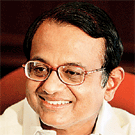
Presenting the budget in the Lok Sabha today, Finance Minister, Shri P.
Chidambaram, announced a new insurance scheme for workers in the unorganized sector, setting up of institutes of higher learning and 6000 high-quality model schools, and provision of Rs. 16,000 crore to cover all rural districts under National Rural Employment Guarantee
Scheme (NREGS).
Under the debt waiver and relief package, small and marginal farmers (with holdings up to 2 hectare) there will be a complete waiver of all loans overdue on December 31, 2007 and which remained unpaid until February 29, 2008. For other farmers, there will be a one-time settlement (OTS) scheme. Under the OTS, a rebate of 25 per cent will be given against payment of the balance 75 per cent. Loans re-scheduled in 2004 and 2006 through special packages and those re-scheduled in the normal course will also be eligible for a waiver or an OTS. The debt relief scheme will be implemented by June 30, 2008 and the covered farmers will be entitled to fresh farm loans from banks in accordance with normal rules. The total value of overdue loans being waived is estimated at Rs. 50,000 crore and the OTS relief at Rs.10,000 crore. The scheme is likely to benefit about three crore small and marginal farmers and one crore other farmers.
Expressing the hope that the target of agricultural credit for 2007-08 would be exceeded, the Finance Minister has set the target of
Rs. 280,000 crore farm credit in 2008-09. Short-term crop loans will continue to be disbursed at interest rate of 7 per cent per year.
Irrigation sector
More investment is flowing into the irrigation sector. Under the Accelerated Irrigation Benefit Programme, 24 major and medium irrigation projects and 753 minor projects will be completed. The outlay for this programme is being raised from Rs 11,000 crore last year to Rs. 20,000 in 2008-09. The Rain-fed Area Development Programme will be implemented, with an allocation of Rs. 348 crore.
The Government will establish the Irrigation and Water Resources Finance Corporation with an initial capital of Rs. 100 crore. This Corporation will mobilize resources for major and medium irrigation projects.
Initiatives for rejuvenating the agricultural sector include setting up of 500 soil testing
laboratories, introduction of crop insurance scheme for plantation crops and support to cooperative sector reforms.
PDS: The budget provides Rs. 32,667 crore for food subsidy under the Public Distribution
System (PDS). As a new initiative for efficient delivery of food grains under the PDS, smart cards are being introduced in Haryana and Chandigarh, on pilot basis.
Indira Awas Yojana: Keeping in mind the higher cost of construction of houses by the poor, the subsidy per unit for new houses sanctioned under Indira Awas Yojana after April 01, 2008 is being enhanced from Rs. 25,000 to Rs.35,000 in plain areas and from Rs.27,500 to Rs.38.500 in hilly/difficult areas. The subsidy for upgradation of houses goes up from
Rs. 12,500 per unit to Rs.15,000. Loans up to Rs.20,000 per unit under the Indira Awas Yojana will be available at the interest rate of 4 per cent.
Education and Health sectors
Calling the education and health sectors ‘the twin pillars on which rests the edifice of
social sector reforms’, the Finance Minister announced 20 per cent increase in budget allocation for education and 15 per cent for the health sector.
In the area of school education, a model school programme with the aim of establishing 6,000 high quality model schools has been announced. Mid-day meal scheme is to be extended to upper primary classes in Government and Government-aided schools in all blocks of the country. Nehru Yuva Kendras will be opened in all the 123 districts which presently do not have an NYK. In higher education, three IITs are to be set up in Andhra Pradesh, Bihar and
Rajasthan; two IISERs at Bhopal and Thiruvananthapuram; two Schools of Planning and Architecture at Bhopal and Vijayawada; and one Central University in each of the hitherto uncovered States. To encourage children to take up science and R&D,
scholarships will be given to students under a new scheme, Innovation in Science Pursuit for Inspired Research (INSPIRE).
Highlighting the need for launching a world class skill development programme in mission mode, the budget seeks to establish a non-profit corporation. The Government will put Rs. 1,000 crore as initial equity in the corporation. Continuing the scheme of upgradation of ITIs, the budget provides Rs.750 crore for upgrading 300 more ITIs in 2008-09. In the Health sector two major interventions are planned. Under the Rashtriya Swasthya Bima Yojana every worker in the unorganized sector falling under the BPL category and his family will get health cover of Rs. 30,000. For the elderly a National Programme for the Elderly is to be started in 2008-09.
The budget provides for Rs. 1,000 crore for the Aam Admi Bima Yojana that provides insurance cover to poor households. This will cover one crore poor households in addition to the one crore likely to be covered by September 30 this year. Funds have also been enhanced for the Indira Gandhi National Old Age Pension Scheme. This Scheme has been expanded from November 19 last year to include all persons over 65 years falling under the BPL category.
National Rural Employment Guarantee Scheme
Allocations for the Flagship Programmes have been enhanced. Provision has been made to expand the National Rural Employment Guarantee Scheme to cover all 596 rural districts. For providing potable water to schools in water deficient habitations, provision for installing stand-alone systems is being made under the Rajiv Gandhi Drinking Water Mission.
Schemes benefiting SCs and STs exclusively have been provided
Rs. 3,966 crore and for schemes where at least 20 per cent of the benefits are earmarked for SCs and STs, the budget provides
Rs. 18,983 crore.
The schemes announced for the welfare of the minorities include a multi sectoral
development plan to be drawn for each of the minority concentration district and a scheme for modernizing Madrassa education. The allocation to the Ministry of Minority Affairs has been doubled to Rs. 1,000
crore.
Women and Child Development
The budget has a number of initiatives for women and children. The allocation to the
Ministry of Women and Child Development has been enhanced by 24 per cent to Rs. 7,200 crore. For the first time, a statement on child related schemes has been introduced in the budget. The total expenditure on schemes for child welfare would be of the order of Rs. 33,434 crore. Rs.11,460 crore has been provided for 100 per cent women specific
schemes and Rs. 16,202 crore for schemes where at least 30 per cent is earmarked for women-specific
programmes. LIC is being asked to extend the Janashree Bima Yojana to cover all women Self Help Groups that are credit-linked to the banks.
North-Eastern region
The North-Eastern region continues to receive special attention in this year’s budget also. The total budget allocation for this region has been raised by over Rs. 2,000 crore to Rs. 16,447 crore. The government proposes to identify the urgent need of border areas in the north-east and address them through a special mechanism, and for this a Rs. 500 crore fund is being established.
Income Tax
The Finance Minister has raised the income tax exemption limit from
Rs. 1,10,000 to Rs. 1,50,000, thus giving every assessee a relief at minimum of Rs. 4,000. The tax rate will be 10 per cent for the income slab between Rs. 1,50,001 and Rs. 3,00,000 and 20 per cent between Rs. 3,00,001 and Rs. 5,00,000. For income of Rs. 5,00,001 and above the income tax rate will be 30 per cent. The exemption limit for women assessees has been increased to Rs. 1,80,000 and in case of senior citizens to Rs. 2,25,000. The Finance Minister has not proposed any change in corporate income tax and in the rate of surcharge. A person paying medical insurance premium for his parents will be allowed an additional deduction of Rs. 15,000 under Section 80D. Justifying the changes in the slabs for personal income tax Shri Chidambaram said that moderation will beget revenues and fairness will beget compliance.
Service Tax
The Finance Minister has brought four more services under the service tax net. They
include asset management service provided under ULIP, services provided by
stock /commodity exchanges and clearing houses, right to use goods in cases where VAT is not payable, and customized software. He also clarified that money changers, persons running games of chance and tour operators using contract carriage vehicles are liable to service tax. He, however, increased the threshold limit of exemption for small service providers from Rs. 8,00,000 per year to Rs. 10,00,000. He said 65,000 small service providers will go out of the tax net.
DUTY
On the indirect taxes front, the Finance Minister has made no change in the peak rates of customs duty. The customs duty on project imports has been reduced from 7.5 per cent to 5 per cent. He has proposed to impose a 4 per cent special countervailing duty on a few specified projects in the power sector. Duty on steel melting scrap and aluminum scrap has been reduced from 5 per cent to nil. Customs duty on certain life saving drugs and on the bulk drugs used in the manufacture of such drugs has been reduced from 10 per cent to 5 per cent and also to totally exempt them from excise duty or countervailing duty. Specific parts of set top boxes and specified raw materials for use in IT and electronic hardware industry have been fully exempted from customs duty. Specific machinery for manufacturer of sports goods, vitamin pre-mixes, mineral mixtures and phosphoric acid used for
manufacture of cattle and poultry fields have been given duty concession.
In order to support domestic fertilizer production, customs duty on crude and unrefined sulphur has been reduced from 5 to 2 per cent. Export duty on chrome ore has been
increased from Rs. 2000 to Rs.3000 per metric tonne to conserve chrome ore. The Finance Minister has proposed to reduce the general CENVAT on all goods from 16 per cent to 14 per cent. Excise duty on all goods produced in the pharmaceutical sector has been reduced from 16 per cent 8 per cent.
Excise duty on buses and their chassis, small cars, two and three wheelers has been
reduced from 16 per cent to 12 per cent. Water purification devices, flush doors, specified packaging material and breakfast cereals will attract excise duty at 8 per cent. Anti AIDS drug, Atazanavir has been totally exempted from excise duty. To encourage cold chain facilities, the Finance Minister has proposed to exempt excise duty on refrigeration equipment above two tonne refrigeration utilizing power of 50KW and above. Bulk cement will now attract excise duty of Rs. 400 per metric tonne or 14 per cent ad
valorem, whichever is higher. Cement clinkers will be liable to excise duty of Rs. 450 per metric tonne. Excise duty of packaged software has been increased from 8 to 12 per cent. An excise duty of one per cent on polyester filament yarn, called
NCCD, has been removed and imposed on cellular mobile phones.
Investment
Emphasizing that there has been an unmistakable boom in investment, the Finance Minister said the Government will provide Rs. 16,436 crore as equity support and Rs. 3,003 crore has loans to Central Public Sector
Enterprises.
The corpus of the Rural Infrastructure Development Fund is proposed to be raised to Rs. 15,000 crore during the coming year. Shri Chidambaram said that there has been some moderation in the index of production of the six core infrastructure industries as well as in the overall index of industrial production from April to December, 2007. He said the decline has been somewhat sharp in the case of consumer goods.
Power
The Finance Minister has provided Rs. 5,500 crore for the Rajiv Gandhi Grameen
Vidyutikaran Yojana, Rs. 800 crore for the Accelerated Power Development and Reforms Project and increased the outlay on National Highway Development Programme from Rs. 10,867 crore to Rs. 12,966
crore.
Technology Upgradation
The outlay on Technology Upgradation Fund run by the Ministry of Textiles has been increased from Rs. 911 crore in the current year to Rs. 1090 crore. Rs. 340 crore has been allocated for the cluster approach to development of the handloom sector. In order to scale up both infrastructure and production, the Finance Minister proposes to take up six centres for development as mega clusters. They include Varanasi and Sibsagar for handlooms, Bhiwandi and Erode for powerlooms and Narsaspur and Moradabad for handicrafts. An initial provision of Rs. 100 crore has been made for the mega clusters.
Relief to Exporters
Recognizing that exports have come under some pressure due to appreciation of the
Rupee, the Finance Minister said the Government has given relief to exporters in three tranches of over Rs. 8000 crore and Rs. 8351 crore in the form of interest cost of market stabilization bonds. He said the Government is sensitive the needs of the exports sector and will continue to respond sympathetically as the situation demands.
Capital Market
On the capital market front, he announced some measures to expand the market for corporate bonds. He said, the requirement of PAN will be extended to all transactions in the financial market subject to suitable threshold exemption limit.
Games and Arts
The Finance Minister has provided Rs. 624 crore for the commonwealth games,
Rs. 75 crore to ICCR to promote India’s music literature, dance, art and films, Rs. 50 crore to the National Tiger Conservation Authority to raise and deploy a special protection force.
Defence: The allocation for the defence has been raised by 10 per cent from
Rs. 96,000 crore to Rs. 105,600 crore.
The total plan expenditure will be Rs. 243, 386 crore and the non-plan
expenditure is estimated at Rs. 507,498 crore. The fiscal deficit for 2008-09 has been estimated at Rs. 133,287 crore which is 2.5 per cent of GDP. He said, significant liabilities of the Government on account of oil, food and fertiliser bonds are currently below the line. He said, after the obligations on account of the Sixth Central Pay Commission become clear he would request the Thirteenth Finance Commission to revisit the roadmap for fiscal adjustment.
CENVAT on all goods cut to 14%
Finance Minister P. Chidambaram proposes
to:
1). Reduce the excise duty on all goods produced in the pharmaceutical sector from 16% to 8%.
2). Reduce the excise duty on buses and their chassis from 16% to 12%.
3).Reduce the excise duty on small cars from 16% to 12% and on hybrid cars from 24% to the general revised
rate of 14%.
4). Reduce the excise duty on two wheelers and three wheelers from 16% to 12%.
5). Reduce the excise duty on paper, paper board and articles made
there from manufactured out of non-conventional raw materials by units not having an attached bamboo/wood pulp making plant from 12% to 8% with a further reduction on clearances up to 3,500 MT from 8% to nil. Furthermore, excise duty on certain varieties of writing, printing and packing paper will be reduced from 12% to 8%.
6). Reduce the excise duty from 16% to nil on a few items, including composting machines, wireless data cards, packaged coconut water, tea and coffee mixes, and puffed rice.
7). The excise duty will be reduced from 16% to 8% on a few items, including water purification devices, veneers and flush doors, sterile dressing pads, specified packaging material, and breakfast cereals.
8). Totally exempt from excise duty the anti AIDS drug, Atazanavir, as well as bulk drugs for its manufacture.
9). To exempt from excise duty, on end-use basis, refrigeration equipment above 2 TR (tonne refrigeration) utilising power of 50 KW and above.
10). To bring parity in the excise duty rates on bulk cement and packaged cement. Accordingly, bulk cement will now attract excise duty of Rs.400 per metric ton or 14% ad
valorem, whichever is higher. Cement clinkers will be liable to excise duty of Rs.450 per metric ton.
11). To increase the excise duty on packaged software from 8% to 12% to bring it on par with customised software which will attract a service tax of 12%.
12). Non-filter cigarettes are more toxic than filter cigarettes, yet they enjoy a favourable tax regime, which is iniquitous. Chidambaram proposes to tax both filter and non-filter cigarettes on par by applying the higher rates.
13). In order to remove a source of misinformation, the ad valorem part of the excise duty on unbranded petrol and unbranded diesel will be abolished and will be replaced by an equivalent specific duty of Rs.1.35 per
litre. Henceforth, there will be only a specific duty of Rs.14.35 per litre on unbranded petrol and Rs.4.60 per litre on unbranded diesel. There will be no impact on retail prices.
14). An excise duty of 1% called NCCD is now imposed on polyester filament yarn, which is the only yarn suffering this excise duty. The Finance Minister proposes to remove that duty and shift the levy to cellular mobile phones.
Income Tax
While raising the income tax exemption limit to Rs 1.5 lakh from 1.1
lakh, the working class people will benefit by up to Rs 44,000 a year in income tax following the changes proposed by the Finance Minister in the Union Budget for 2008-09, which also provides for a minimum benefit of Rs 4,000.
Finance Minister P Chidamabaram also provided for lower tax rates for income up to Rs 5
lakh.
Earlier, the minimum exemption limit stood at Rs 1.1 lakh for all classes of individuals. For women, the
exemption limit has been raised to 1.8 lakh from 1.45 lakh previously, while for senior citizens it has been
hiked from Rs 1.95 lakh to Rs 2.25 lakh.
For an income of Rs 10 lakh a year, an individual would have to pay a tax of Rs 2,05,000, as against Rs 2,49,000 under the previous tax structure. For women assessees, a similar income would attract a tax of Rs 2,02,000 under the new regime, down from Rs 2,45,500 previously, while the tax for senior citizens would drop to Rs 1,97,500 from Rs 2,36,000 earlier.
According to the proposals, income between Rs 1.5-3 lakh will be taxed at 10 per cent, between Rs 3-5 lakh at 20 per cent, while for Rs 5-10 lakh it would be 30 per cent.
|