|
CPM leader Jyoti Basu
last journey
Kolkata, January 19, 2010:: Thousands of people tried to break
police barricades for a last glimpse of their leader Jyoti Basu, as
the flower-bedecked body of the Communist patriarch was brought to the
Communist Party of India-Marxist (CPI-M) West Bengal state
headquarters in Kolkata on Tuesday. Tearful CPI-M politburo members,
including general secretary Prakash Karat and chief ministers of West
Bengal, Kerala and Tripura, carried the body on their shoulders from
the hearse and placed it on a makeshift platform, as slogans like 'Jyoti
Basu amar rahe' and 'Long Live Jyoti Basu' rent the air.
Six pall bearers drawn from the three wings of the Defence
forces took the body of CPI(M) veteran Jyoti Basu from the assembly
premises, where it was lying in state, to a gun carriage for the last
journey to Mohur Kunj today. The pall-bearers carried the body,
draped in the national tri-colour, to the gun carriage at the north
gate. The body was placed on the gun-carriage draped with a red cloth
and as it began moving soldiers with reversed arms marched beside it
to the roll of drums.
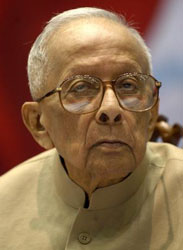
Jyoti Basu: 1914-2010
Former chief minister of West Bengal and veteran communist leader of India, Jyoti
Basu, breathed his last on Sunday, January 17, 2010. Announcing his death, CPI (M) state secretary Biman
Bose, said that Basu passed away at 11: 47 am. The 95-year-old communist leader was admitted at a private nursing home in Kolkata on January 1 with mildly severe pneumonia.
His condition deteriorated steadily and he was put on ventilation on January 6. His lungs stopped
functioning a few days later. He developed multi organ dysfunction. Senior political leaders from all over the country, including the Prime Minister Manmohan Singh, visited Basu during the last 17 days. His
condition continued to deteriorate and dialysis was done since the last three days.
On Saturday night, Basu's heart rate dropped abnormally and a temporary pace maker had to be placed to keep his heart functioning. Doctors had gathered at the hospital on Saturday night itself. Basu was to undergo dialysis on Sunday. But on Sunday morning, doctors decided that Basu was not in a condition to undergo dialysis. Basu's body is being taken to Peace Haven where it would be kept for today. The CPI (M) state secretariat will meet at 6 pm today to decide about how to pay last homage to Basu on Monday and Tuesday.
All the national leaders of the CPI (M) including party secretary Prakash Karat, rushed to the hospital on Sunday morning. Basu had donated his eyes and body.Earlier Trinamool chief Mamata Banerjee visited the hospital where Basu was being treated. "I respect him as a senior polititian. We have stopped all party programs for the next three days. I demand three days of official mourning,"
Mamata said.Born on July 8, 1914, he was the chief minister of Bengal between June 21, 1977 to November 6, 2000.
Following is a chronology of his life:
- Born in Calcutta (now Kolkata), July 8, 1914.
- Graduated from Presidency College with honours in English. He did
his Bar at Law from London where he got introduced to Marxism and politics.
- Returned to India in 1940. Joined Communist Party of India (CPI).
- In 1944 he was a functionary of Bengal railway workers' union.
- In 1946 he was elected to the Bengal legislative assembly, defeating Humayun Kabir of Congress.
- He won from Baranagar assembly constituency in 1952, 1957, 1962, 1967, 1969 and 1971. He lost the seat in the 1972 snap polls.
- In 1964, he helped set up the Communist Party of India-Marxist (CPI-M).
- In 1967, he became deputy chief minister in a coalition government in Bengal.
- Became chief minister of West Bengal June 21, 1977 and headed the Left Front government till Nov 6, 2000.
- Narrowly missed a chance to become India's prime minister in 1996 after his party's veto. He later called the party decision a "historic blunder".
- In 2000, he announced his retirement from active politics and stepped down as chief minister on health grounds.
- In 2004, he played a key role to stitch an alliance between the Left parties and the Congress-led United Progressive Alliance (UPA).
|
|


